Only a few minutes from where I live is Brey Cycle Farm, LLC. Recently I had an opportunity to pay a visit and receive a tour of the dairy operation.
Cycle Farm takes its name from the cycle of sustainability which is central to what they do. All of their beef and dairy animals are born and raised on the farm here in Door County. Cycle Farm was established in 1904 by George Brey Sr., great-grandfather of Tony and Jacob who purchased the farm from their parents Bill and Clarice Brey in 2016. Today about 1,500 cows are milked and calves and heifers are raised. Cycle Farm also raises Angus/Holstein crossbred beef animals along with custom heifers for other farms. As stewards of the land high quality forage
crops are grown on 2,000 acres of owned and rented land for livestock feed. In addition to family members there are an additional twenty full-time employees and several part-time employees.
Cycle Farm is a member of Peninsula Pride Farms, a farmer-led conservation group, and are participants in the Door-Kewaunee Demonstration Farms Network.
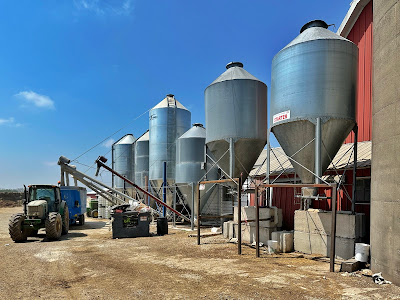
Calves are fed mother's colostrum at birth to provide immunity and nutrition. Housed in individual hutches for individual attention and health they are fed pasteurized milk twice a day along with fresh water. After a week a grain mix is introduced to supplement the milk. Calves are weaned after 60 days and moved to a group pen. Feed is a total mixed ration (TMR) of forage, grains, minerals, vitamins, minerals and protein for balanced nutrition.
 |
| Maternity ward |
 |
| Couple of hours old |
Cows like moderate temperatures so they are housed in in freestall barns keeping them shaded and cool in the summer and warm in the winter. This set-up allows the animals to eat, drink, move-about and lie down as they please while protecting them from inclement weather. Cows are fed a custom TMR and have access to fresh water all the time and their pens are cleaned each time they are in the milking parlor.
 |
| TMR Cuisinart |
 |
| Girls returning from milking parlor |
Speaking of which, cows are creatures of habit consequently they are milked three times at the same time each day. The parlor can handle 26 cows at a time and machines keep track of pounds, temperature and quality with each animal producing an average of 10 gallons of milk daily. Milk is shipped to Agropur in Luxemburg, WI for the production of mozzarella and provolone.
 |
| Bulk milk storage |
Acreage is routinely tested for pH, organic matter, phosphorus and potassium. Manure from the animals is stored in a pit until conditions are appropriate for application by spreading, injection or drag hose. Testing is GPS managed, collecting 1 sample per 2.5 acres to determine nutrient levels impacted by soil types and previous crops grown. An agronomist determines application rates depending-upon soil needs.
In 2021 - 140 acres were converted to paddocks for grazing heifers and beef cattle. Management-intensive grazing is a flexible approach to rotational grazing influenced by paddock size, stocking density and length of grazing. Adjustments are made throughout the grazing season balancing forage supply with animal demand.
In 2024 a screw-press separator was acquired to recycle manure solids for bedding instead of purchasing sand. The device removes undigested fiber in the manure from the liquid and through a simple drying process produces green bedding to keep the animals comfortable in their stalls.
You won't find Brey beef sold in a local grocery; you can call or order online for pick-up at their farm store located at 2190 County Road O, Sturgeon Bay. They offer Bargain Bundle and Freezer Filler packages for a volume discount or you can purchase a package of burgers, wieners, or a steak or roast. Breyfamilybeef@gmail.com or (920) 639-4742. You can learn more on Facebook and visit Brey Family Beef.
 |
| French Vosgienne breed - solitary animal |


 Posts
Posts

