Tuesday, May 5, 2026
National Astronaut Day
Wednesday, December 11, 2024
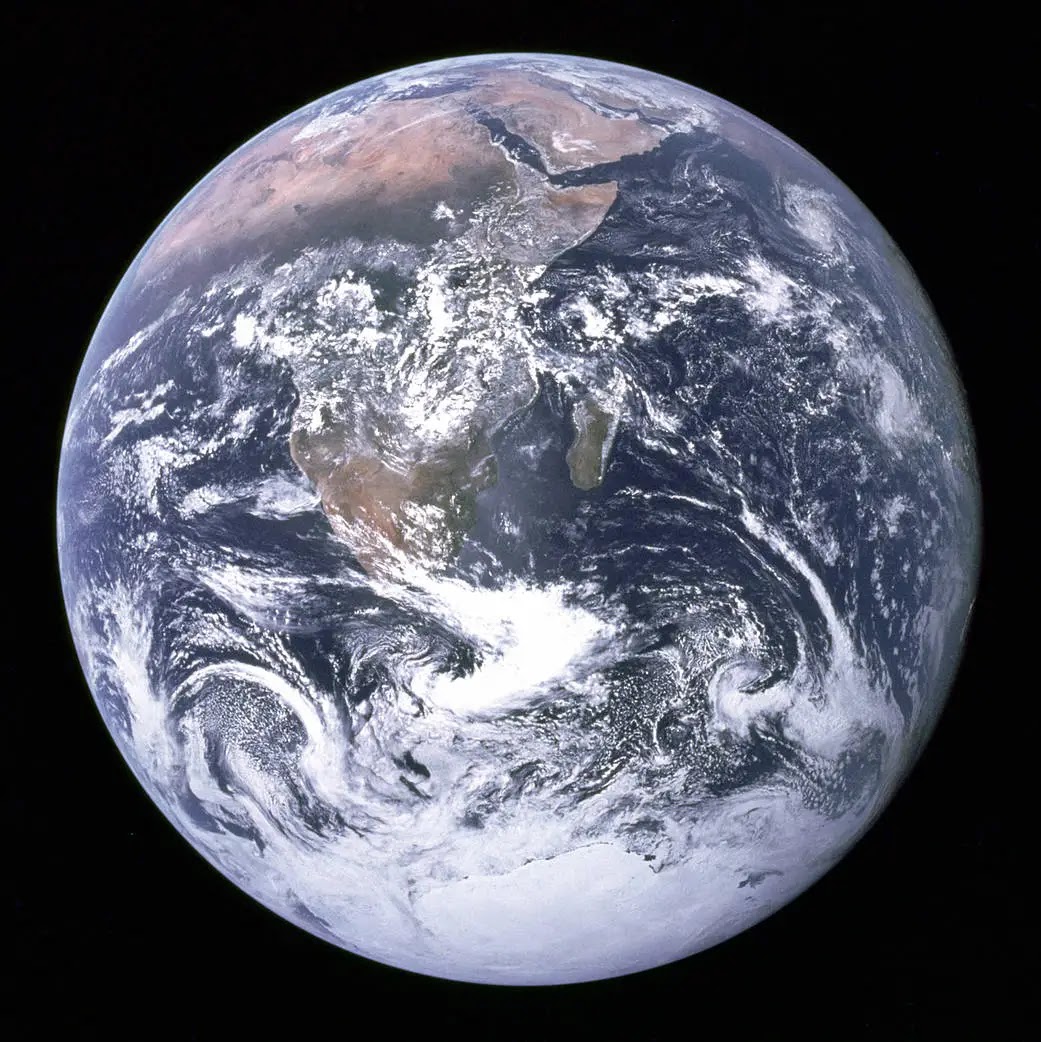
Big Blue Marble
Having launched on December 7, was this view of the earth as seen by Apollo 17 crew - astronauts Eugene Cernan, Ronald Evans and scientist-astronaut Harrison Schmitt - traveling toward the moon. 
image credit - NASA
This translunar coast photograph extends from the Mediterranean Sea to the Antarctica South polar ice cap. This is the first time the Apollo trajectory made it possible to photograph the South polar ice cap.
Take note of the heavy cloud cover in the Southern Hemisphere. Almost the entire coastline of Africa is clearly visible. The Arabian Peninsula can be seen at the Northeastern edge of Africa. The large island off the coast of Africa is the Malagasy Republic. The mainland of Asia is on the horizon toward the Northeast.
On this day in history, December 11, 1972, Apollo 17 became the last manned moon mission. Two astronauts landed the lunar module Challenger, in a location called the Taurus-Littrow Valley spending three days collecting samples from the lunar surface.
Commander Eugene Cernan was the last person to set foot on the lunar surface as he followed lunar module pilot Harrison Schmitt, back onto their space craft to prepare to depart the lunar surface.
Meanwhile, command module pilot Ronald Evans had to hang out orbiting the moon as he awaited the return of his crew mates.
Apollo 17 successfully returned to earth; splashing-down on December 19.
It has been 52 years since humans last explored the lunar surface.....
Monday, February 22, 2021
The Right Stuff
Sixty years ago my folks allowed me to stay home from school so I could watch live television coverage of Alan Shepard riding a Redstone rocket in his Freedom 7 Mercury space capsule to become the first American in space.
Thursday, November 22, 2018
Thanksgiving on the ISS
On the International Space Station, the crew - including Sergey Prokopyev - will share a holiday meal of turkey, stuffing, candied yams and spicy pound cake and call home to speak with loved ones on Earth.
The meal was prepared in Houston, where scientists assemble the food and then dehydrate, radiate or thermostabilize (similar to canning) it to prevent it from spoiling,
Packaged in individual vacuum-sealed bags, which are carried into orbit and kept safe in a locker until Thanksgiving. The food is prepared on the ISS by adding hot water or putting it in a small warming oven.
Thursday, January 11, 2018
Growing Your Own Air Purifier
Monday, December 28, 2015
Earth Rise
This NASA high resolution image was taken by the the Lunar Reconnaissance Orbiter (LRO).
This image was composed from a series of images taken Oct. 12, when LRO was about 83 miles (134 kilometers) above the moon's farside crater Compton. Capturing an image of the Earth and moon with LRO's Lunar Reconnaissance Orbiter Camera (LROC) instrument is a complicated task. First the spacecraft must be rolled to the side (in this case 67 degrees), then the spacecraft slews with the direction of travel to maximize the width of the lunar horizon in LROC's Narrow Angle Camera image. All this takes place while LRO is traveling faster than 3,580 miles per hour (over 1,600 meters per second) relative to the lunar surface below the spacecraft!
You can learn more about it here.
Sunday, June 19, 2011
Fire!
The Moderate Resolution Imaging Spectroradiometer (MODIS) on NASA's Terra satellite acquired this image of the fires on June 16, 2011 at 18:00 UTC (2:00 p.m. EDT). Active fire areas appear as red dots, and smoke is blowing to the northeast.
Here is some time-lapse imagery from NASA’s Multi-angle Imaging SpectroRadiometer (MISR) instrument on the Terra spacecraft of the the Wallow and Horseshoe 2 Fires burning in Arizona mid-morning (local time) on June 7, 2011.
511,118 acres burned so far witth no end in sight.