Showing posts with label Rodents. Show all posts

Monday, November 24, 2025

Stash

Cleaning-up and getting things ready for winter The Missus fetched the cushions from the chairs on the porch and stored them in the garage.

Some mouse is going to be pissed about his stash of seeds and a mother lode of an acorn being swept-up in fall chores...


Sunday, November 16, 2025

Buddy Squirrel


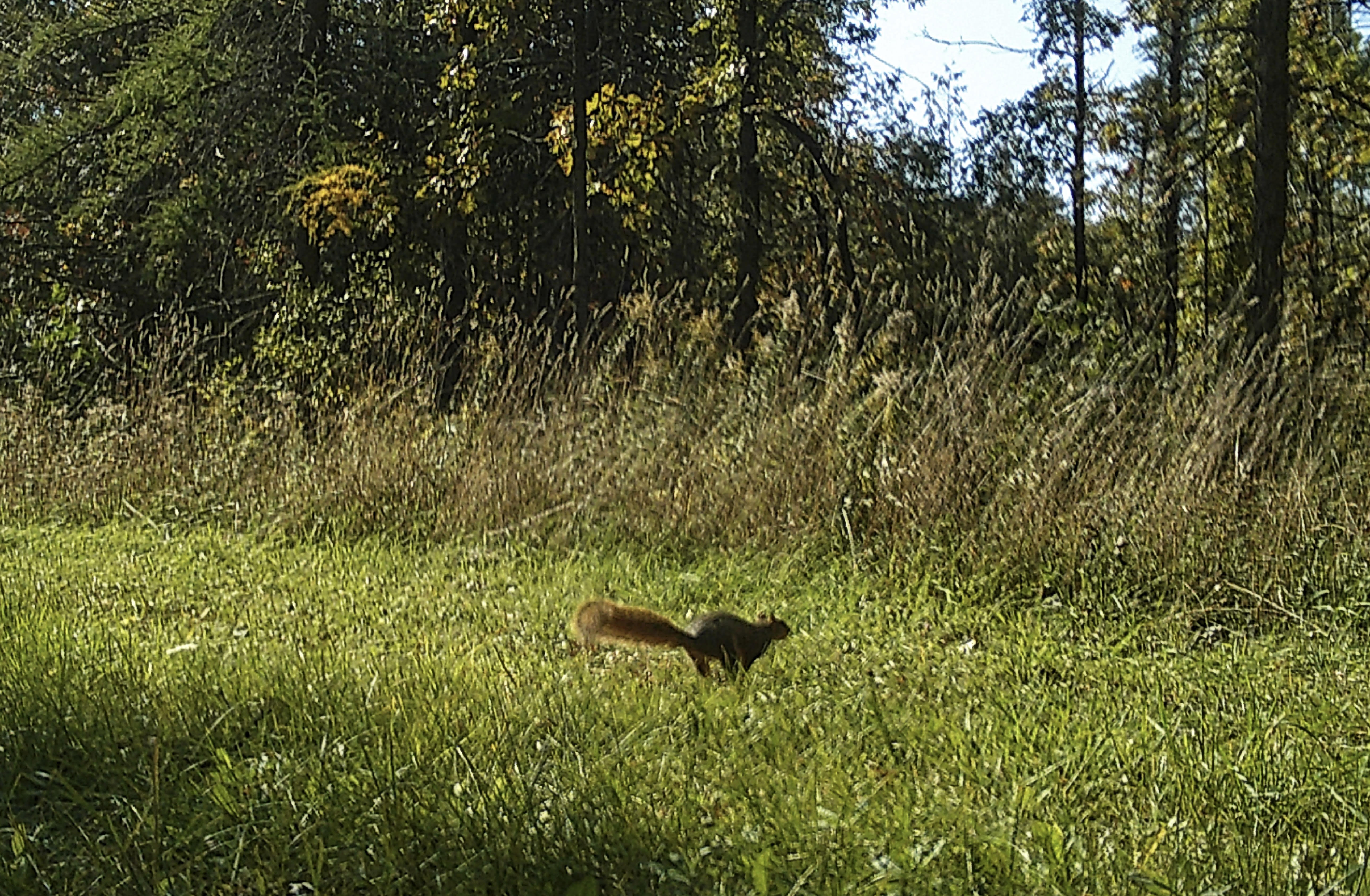
Meet Sciurus niger - the Eastern Fox Squirrel - the largest of the tree squirrel family.  The common gray squirrel is slightly smaller. 

At first blush you might guess this to be a Red Squirrel.  However, lacking in this photo is the Red Squirrel's distinctive bright white belly and white rings around the eyes.  The rusty coloring and large bushy tail are reminiscent of a fox - implying this is a Fox Squirrel.  

The bright reddish-orange pelt of this animal and it's loud, scolding call make it an easier visual and audible identification.  Unlike the Eastern Gray Squirrel this species has a wider home range and, as is evidenced by all of the photos, spends more time on the ground foraging. 

In the past six years they've been showing-up with increasing frequency on the trail cameras.  My conclusion is that as our forest has matured, along with acorn production from the oaks, is that the resident population has increased.  

They're active year-round and January and February is their mating season so there's likely more chasing of the ladies happening too.  This time of year their frequent appearances are a consequence of gathering stores for winter.


Fun to observe and without destructive tunneling in our septic mound I'm tickled (so far anyway) to have them around.


Wednesday, October 15, 2025

Foxy Rodent

Meet Sciurus niger - the Eastern Fox Squirrel - the largest species of tree squirrel native to North America. 


At first blush you might guess this to be a Red Squirrel.  Fox squirrels are the larger of the two and have rusty brown fur with a pale yellow to orange belly.  Lacking in this photo is the Red Squirrel's distinctive bright white belly and more pronounced white rings around the eyes.  The rusty coloring and large bushy tail are reminiscent of a fox - implying this is a Fox Squirrel.  From time to time this species produces black squirrels with a white belly, nose and white-tipped ears.  The translation of the Latin - Sciurus niger - is black squirrel.   


The bright orange pelt of this animal and it's loud, scolding call make it an easier visual and audible identification.  Unlike the Eastern Gray Squirrel this species has a wider home range and spends more time on the ground foraging.  They return with their food to a preferred dining location.  If you happen-upon a debris midden of corn cobs and split nutshells you will have found ‘that spot’.  This species buries nuts for retrieval at a future date - which probably accounts for all the tiny oak trees popping-up around the joint.

Sunday, October 23, 2022

Foxy Red Head

This rodent first appeared in our woods in 2018.  Four years later they have become quite common.  And with our oaks bearing fruit I suspect the population will continue to thrive. 

Meet Sciurus niger - the Eastern Fox Squirrel - the largest of the tree squirrel family.  The gray squirrel is more common but is slightly smaller. 


At first blush you might guess this to be a Red Squirrel.  However, lacking in the photos is the Red Squirrel's distinctive bright white belly and white rings around the eyes.  The rusty coloring and large bushy tail are reminiscent of a fox - implying this is a Fox Squirrel.  

The bright orange pelt of this animal and it's loud, scolding call make it an easier visual and audible identification.  Unlike the Eastern Gray Squirrel this species has a wider home range and spends more time on the ground foraging.  Just like this picture suggests.... 

 
This species also buries nuts for retrieval at a future date - which probably accounts for all the tiny oak trees popping-up around the joint.

Thursday, October 28, 2021

Woodland Redhead

Meet Sciurus niger - the Eastern Fox Squirrel - one of the larger of the tree squirrel family although slightly smaller than the common gray squirrel. 

At first blush you might guess this to be a Red Squirrel.  However, lacking in this short, silent video clip is the Red Squirrel's distinctive bright white belly and white rings around the eyes.  The rusty coloring and large bushy tail are reminiscent of a fox - implying this is a Fox Squirrel.  

The bright orange pelt of this animal and it's loud, scolding call make it an easy visual and audible identification.  Unlike the Eastern Gray Squirrel this species has a wider home range and spends more time on the ground foraging.  Just like this video suggests.

Bonus is the whitetail deer pal in the background. 

Sunday, March 7, 2021

What Makes This Critter Guard His Musk?

If you are a Wizard of Oz fan and recall the soliloquy of the Cowardly Lion you already know the answer to the title of this blog post – Courage!  

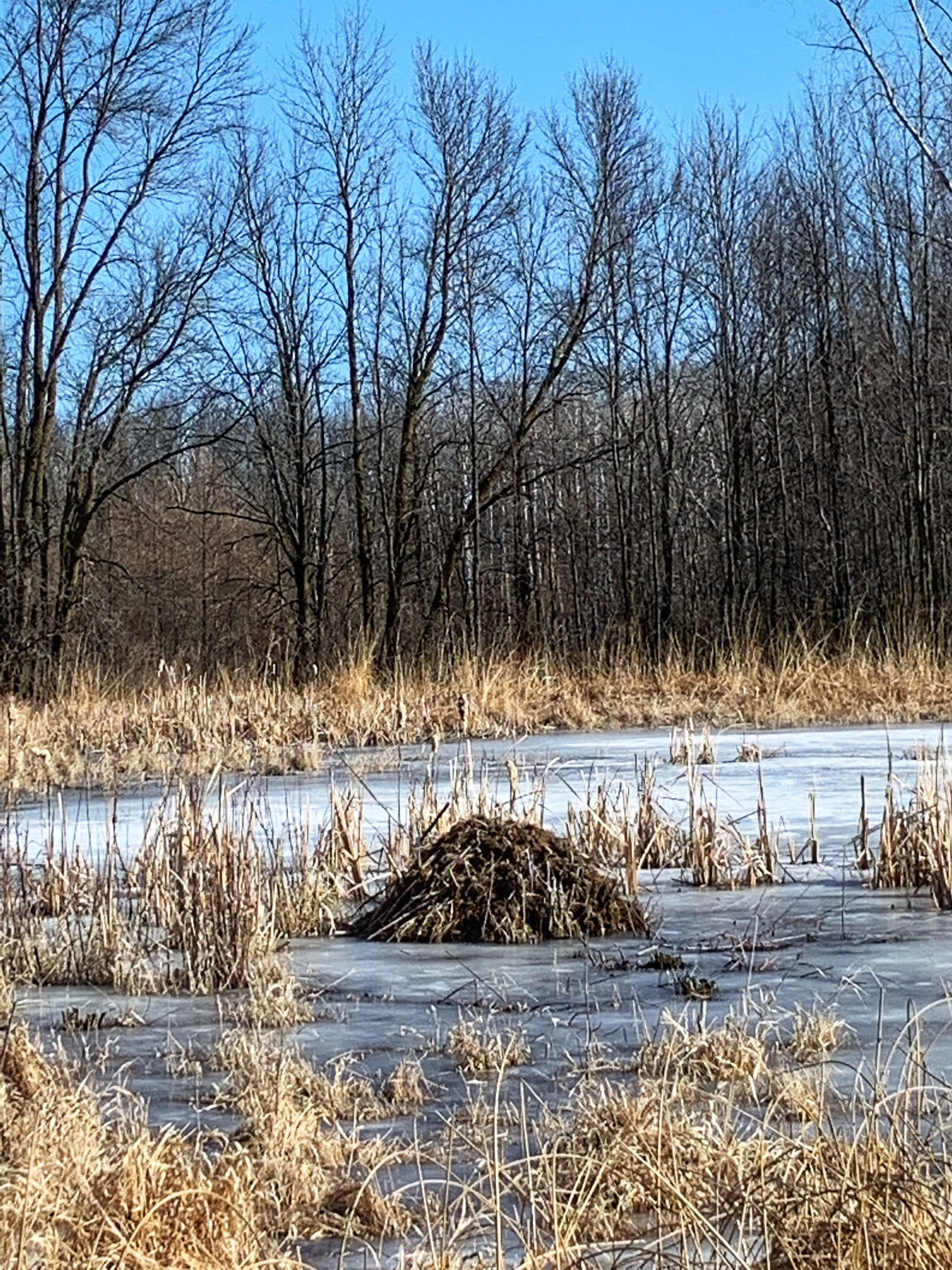
On Friday Blonde Dog and I were out for a walk and we figured we’d take advantage of the frozen conditions around the pond to check on one of our resident aquatic residents.  

Meet Ondatra zibethicus – The Muskrat – aptly named as a consequence of its long naked tail and musky odor (quite noticeable in the male during the breeding season).   

The muskrat is ideally-suited to living in a watery environment and sports a waterproof fur coat, webbed feet and a tail that can be used like a rudder.  This chunky rodent can stay submerged for up to fifteen minutes before having to surface for air.  

Since the spring of 2012 muskrats have called our large pond out back between the house and Silver Creek home.  They built and enlarged their original home and constructed a second one several years ago.  By the close of 2020 the second lodge had disappeared into the depths of the pond.  


Not all muskrats build lodges – with some choosing to dig a burrow in a stream bank or lake shore.  Our rats are builders (as near as I can tell) and this is their lodge constructed of mud and cut vegetation.  The outer roof extends more than 30 inches above the surface of the ice.  

Muskrat lodges have one to two underwater entrances and may have a second chamber for different occupants.   They’re fastidious about their den and will not use it as a bathroom.  

The muskrat does not hibernate and is active year-round.  Living up to ten years in age breeding begins in April and ends with the return of fall weather.  Around half a dozen young are born two to three times a year and the little ones can swim at two weeks of age.      


Unlike the beaver - who occupies only one lodge per lake or stream - the muskrat may build multiple abodes.  

However, overcrowding will cause the critter to disperse and to find a new home.   


Wednesday, February 3, 2021

Tracking

From our walk this morning it was 22 F and sunny - no gloves or hat required

Blonde Dog and I did some tracking 


We crossed the Oregon Trail of rodent tracks (sun low on the horizon = long tall shadow) 


Some sort of canid came loping thru leaving pairs of tracks spaced 5-6 feet apart


Smaller, closely-spaced tracks belong to a cat or racoon?


Saturday, October 3, 2020

Foxy Redhead

Meet Sciurus niger - the Eastern Fox Squirrel - the largest species of tree squirrel native to North America.   


At first blush you might guess this to be a Red Squirrel.  Fox squirrels are the larger of the two and have rusty brown fur with a pale yellow to orange belly.  Lacking in this photo is the Red Squirrel's distinctive bright white belly and more pronounced white rings around the eyes.  The rusty coloring and large bushy tail are reminiscent of a fox - implying this is a Fox Squirrel.  From time to time this species produces black squirrels with a white belly, nose and white-tipped ears.  The translation of the Latin - Sciurus niger - is black squirrel.       

The bright orange pelt of this animal and it's loud, scolding call make it an easier visual and audible identification.  Unlike the Eastern Gray Squirrel this species has a wider home range and spends more time on the ground foraging.  They return with their food to a preferred dining location.  If you happen-upon a debris midden of corn cobs and split nutshells you will have found ‘that spot’.  

This species also buries nuts for retrieval at a future date - which probably accounts for all the tiny oak trees popping-up around the joint.

Thursday, January 30, 2020

Tracks

click on the image for a closer look


Fetching wood the other day some fresh snow had blown under the door to collect on the floor of the barn.

Perfect way to verify that it remains occupied by the resident mice.

Yes, those are dog tracks in the concrete...

Friday, January 3, 2020

Science Comes to Friday Music

A year ago yesterday Daryl Dragon passed away at the age of 76.  Trained as a classical pianist Dragon is best remembered as the other half of a 70’s pop sensation performing as Captain and Tennille.  Dragon was married to Toni Tennille.  One of their hits has a syrupy concoction called Muskrat Love. 

Meet Ondatra zibethicus – The Muskrat – aptly named as a consequence of its long naked tail and musky odor (quite noticeable in the male during the breeding season).   The muskrat is ideally-suited to living in a watery environment and sports a waterproof fur coat, webbed feet and a tail that can be used like a rudder.   This chunky rodent can stay submerged for up to fifteen minutes before having to surface for air.   

For a number of years muskrats have been making their home in the large pond out back between the house and Silver Creek.  Not all muskrats build lodges – with some choosing to dig a burrow in a stream bank or lake shore.  Our rats appear to be builders as opposed to diggers and this is their lodge constructed of mud and cut vegetation. 


This particular home is the largest one we’ve seen so far.  The roof is approximately 30 inches above the surface of the ice. 

Muskrat lodges have one to two underwater entrances and may have a second chamber for different occupants.  They’re fastidious about their den and will not use it as a bathroom.  The muskrat does not hibernate and is active year-round.  They can live up to ten years of age in the wild. 

Breeding begins in April and ends with the return of fall weather.  Around half a dozen young are born two to three times a year and the little ones can swim at two weeks of age.            

Unlike the beaver - who occupies only one lodge per lake or stream - the muskrat may build multiple abodes.  Here is a smaller lodge that we’re going to keep an eye on.  We’re not sure if it is under construction or was started and abandoned.

click on images for a closer look
Overcrowding will cause the critter to disperse and to find a new home.          

Getting back to the breeding behavior of the muskrat and what happens in that lodge there is this. 

And you are welcome for the earworm....

Saturday, November 2, 2019

Foxy Redhead

Meet Sciurus niger - the Eastern Fox Squirrel - the largest species of tree squirrel native to North America. 

click on image for a closer look
At first blush you might guess this to be a Red Squirrel.  Fox squirrels are the larger of the two and have rusty brown fur with a pale yellow to orange belly.  Lacking in this photo is the Red Squirrel's distinctive bright white belly and more pronounced white rings around the eyes.  The rusty coloring and large bushy tail are reminiscent of a fox - implying this is a Fox Squirrel.  From time to time this species produces black squirrels with a white belly, nose and white-tipped ears.  The translation of the Latin - Sciurus niger - is black squirrel.   

The bright orange pelt of this animal and it's loud, scolding call make it an easier visual and audible identification.  Unlike the Eastern Gray Squirrel this species has a wider home range and spends more time on the ground foraging.  They return with their food to a preferred dining location.  If you happen-upon a debris midden of corn cobs and split nutshells you will have found ‘that spot’.  This species buries nuts for retrieval at a future date - which probably accounts for all the tiny oak trees popping-up around the joint.

Tuesday, June 18, 2019

Woodland Redhead

This handsome mammal has been showing-up regularly on the trail cameras so the habitat around here must be sufficiently stocked with food and cover since just one of these critters has a home range of up  to fifty acres. 

click on image for a closer look
 
Meet Sciurus niger - the Eastern Fox Squirrel - the largest species of tree squirrel native to North America.  

At first blush you might guess this to be a Red Squirrel.  Fox squirrels are the larger of the two and have rusty brown fur with a pale yellow to orange belly.  Lacking in this photo is the Red Squirrel's distinctive bright white belly and more pronounced white rings around the eyes.  The rusty coloring and large bushy tail are reminiscent of a fox - implying this is a Fox Squirrel. 

The bright orange pelt of this animal and it's loud, scolding call make it an easier visual and audible identification.  Unlike the Eastern Gray Squirrel this species has a wider home range and spends more time on the ground foraging.  They return with their food to a preferred dining location.  If you happen-upon a debris midden of corn cobs and split nutshells you will have found ‘that spot’. 

Wednesday, October 3, 2018

Foxy

Meet Sciurus niger - the Eastern Fox Squirrel - the largest of the tree squirrel family although slightly smaller than the common gray squirrel. 

At first blush you might guess this to be a Red Squirrel.  However, lacking in this photo is the Red Squirrel's distinctive bright white belly and white rings around the eyes.  The rusty coloring and large bushy tail are reminiscent of a fox - implying this is a Fox Squirrel.  

The bright orange pelt of this animal and it's loud, scolding call make it an easier visual and audible identification.  Unlike the Eastern Gray Squirrel this species has a wider home range and spends more time on the ground foraging.  Just like this picture suggests....   

Tuesday, June 26, 2018

Lazarus

Ordinarily I wouldn't make a big production about wildlife in my yard unless their behavior or conditions of their existence begin to become destructive or cause other harm.  If you chose to live in rural America critters are part of the landscape and you share it with them. 

Having said that - if a groundhog begins tunneling and undermining the foundation of your barn you may have to intervene.  Same for mice in your basement.  Or a colony of sociopathic German yellow jacket wasps in the wall of your wife’s potting shed.   Speaking about insect infestations – how about a million, bazillion stinky lady bugs sunning themselves on the sunny side of your house before they move in for the winter?  Ugh.   And then there is the reoccurring matter of ground squirrels tunneling and inhabiting your mound system – or POWTS (Private Onsite Wastewater Treatment System). 

Don’t get me wrong, I have nothing personal against ground squirrels – the Thirteen-lined ground squirrel - Spermophilus tridecemlineatus in particular.  I bear them no grudge.  Nevertheless, the construction of a septic mound and all of its attendant operating systems is quite expensive and to risk its operating efficiency or life span at the hands of tunneling rodents comes with no small amount of consternation.  I have attempted live-trapping them to tittle effect.  They are masters of eventually escaping thru the bars of my smallest live trap.  I dare not attempt poisoning them as a dead squirrel may cause no small amount of harm to a curious and hungry Labrador retriever.  I could shoot them like a sniper – yet that requires rising early and burning daylight when other pressing shores demand attention.  Or there is the always reliable Victor Rat Trap.  Or is it? 

I recently set the trap in the photo – baited with irresistible peanut butter and anchored by means of a stiff wire inserted into the turf – namely to prevent an overnight varmint from easily carrying-off the trap along with a deceased squirrel. 

Twice I found the trap was sprung, the bait gone and no squirrel corpse to provide evidence of its efficacy.  Although it is entirely possible another predator absconded with any deceased squirrel caught in the trap. 

And then one day – as I was working in the garden – I discerned an audible SNAP!  Focusing on the mound I spied a squirrel twitching in the trap and immediately falling still.  I allowed the situation to chill for about twenty minutes and calmly walked to the trap, opened the spring-loaded bale and dropped a presumably dead squirrel to the ground.  Setting the trap aside I reached to pick-up the decedent for disposal when it suddenly arose from the dead and limped sideways in a crab-like fashion about ten feet from me.  This rodent was obviously not well - yet seemingly far from the grip of death. 
 
Determined to end its misery I walked back to the garage to fetch a pistol and returned to the squirrel that had now launched into a loud and clamorous, chattering alarm call.  Chambering a round I prepared to deliver a merciful coup de grâce when the squirrel (now seemingly unimpaired) darted away and disappeared from view with normal ground squirrel haste. 
 
I am not quick to invoke biblical connation to such inexplicable events but that rodent was the gopher equivalent of Lazarus.  Probably a good thing I didn’t shoot it as it was meant to live on.  Meanwhile, they’re still burrowing in the mound and likely a bit more wary of the trap and the guy in the garden. 
 
Back to the drawing board....
  

Tuesday, February 20, 2018

Maus

These tracks on fresh morning snow are evidence of either a white-footed mouse or a deer mouse. 
 
The most common mouse in Wisconsin and most widespread of mouse species across North America is the deer mouse.  And you will find it in nearly every type of habitat within that range.  You will find them in your yard, forest, your shed, nibbling-upon the washer hoses of my Honda CRV and during the winter in my bird nest boxes.  Approach a nest box and get a whiff of a strong smell of urine?  Deer mice have taken-up residence.  It is the most widely distributed and abundant mammal in North America.  

The white-footed mouse is also widely distributed but prefers wooded or brushy areas.  It is sometimes found in open areas. 
 
This rodent is a common source of food for foxes, coyotes, hawks, owls and snakes.  Yes, life is short when you live near the bottom of the food chain - which would explain why they are so prolific.   Litters are 1-8 pups three times a year.   And each is sexually mature at a month and a half of age. 
 
They’re not aggressive and are actually quite tame. 
 

Thursday, December 14, 2017

What Makes the Muskrat Guard His Musk?


If you are a Wizard of Oz fan you already know the answer to the title of this blog post - Courage!

Meet Ondatra zibethicus – The Muskrat – aptly named as a consequence of its long naked tail and musky odor (quite noticeable in the male during the breeding season).   

The muskrat is ideally-suited to living in a watery environment and sports a waterproof fur coat, webbed feet and a tail that can be used like a rudder.   This chunky rodent can stay submerged for up to fifteen minutes before having to surface for air. 

For a number of years muskrats have called our large pond out back between the house and Silver Creek home.   


click on image to enlarge


And they’ve built and enlarged their home.  Not all muskrats build lodges – with some choosing to dig a burrow in a stream bank or lake shore.  Our rats are builders (as near as I can tell) and this is their lodge constructed of mud and cut vegetation.  Muskrat lodges have one to two underwater entrances and may have a second chamber for different occupants.  


They’re fastidious about their den and will not use it as a bathroom.  The muskrat does not hibernate and is active year-round.  Living up to ten years in age breeding begins in April and ends with the return of fall weather.  Around half a dozen young are born two to three times a year and the little ones can swim at two weeks of age.     

Unlike the beaver - who occupies only one lodge per lake or stream - the muskrat may build multiple abodes.  However, overcrowding will cause the critter to disperse and to find a new home.   

Last spring Six Deuce had another wildlife encounter and filmed this muskrat cavorting in Silver Creek.

Monday, October 16, 2017

Big Game Animal

click on the immage to enlarge

Meet Sciurus carolinensis - the Eastern Gray Squirrel.  You're probably thinking I'm color blind because that squirrel is a redhead - hardly gray.

Actually it is a black morph - overall black with a red-like sheen.  The tail is red too.  They're common around these parts.  Besides, it's too large to be a true red squirrel..

Tuesday, July 19, 2016

Excavator


Meet Ictidomys tridecemlineatus


Sometimes called the striped gopher, leopard ground squirrel, squinney, or the leopard-spermophile back in the day this is the thirteen lined ground squirrel.  And a family of them has decided to move in and build a home in the front yard.

That would be until blonde dog discovered one of the tunnels and excavated it. 


Blonde dog is now relentlessly vigilant from her OP on the porch.  Raising the alarm when one of these ground squirrels scurries into sight.