This Chevy
Silverado pick-up still runs like a champ. And it will be celebrating
its 29th birthday in September. That was when it rolled-off the
assembly line in Flint Michigan in 1997.
We take care of our vehicles and tend to run them until the wheels fall-off.
It's
spring-cleaning time around here so when making a trip to the town dump
it's always a delight to rock some Marshall Tucker on the cassette
player.
Who do you know has a working cassette player anymore? Much less, a cassette tape collection....
I've previously blogged about REMCO (Remote Control Manufacturing Company) and toys from the 1960s. It was a golden age and Remco dominated the marketplace for creating toys that made children feel like a cold war spy, a scientist or a backyard warrior. Including fun stuff that you could assemble like a radio.
Before the age of microchips Remco sold a kit that a kit that included all of the components - transistors, capacitors and resistors - that a kid could put together by means of spring-terminals and screws to create a working AM radio.
To keep costs down most models used a one-transistor circuit requiring a long antenna wire that you could clip to a metal window screen or bed frame to enhance reception. Most included a single crystal ear plug while others used a speaker. An entire generation of baby boomers found their way into an engineering career or became ham radio enthusiasts as a consequence of Remco radios.
And if you have a working model with the original packaging and instructions you would learn that collectors and radio hobbyists will pay handsomely to get their hands on it.
In the nuclear-obsessed 1940s, when atomic energy symbolized progress
and modernity, one cereal company decided to ride the wave—though not in
the safest way. In 1947, Kix cereal launched a daring promotion: for
just 15 cents and a cereal box top, children could receive the Lone
Ranger Atomic Bomb Ring.
The ring wasn’t just a toy. It contained a tiny sample of polonium-210, a
radioactive isotope (substance), within a spinthariscope, allowing
users to observe flashes of light caused by alpha particles. The ring
featured a “magic viewing chamber” with a zinc sulfide screen that
glowed when struck by alpha particles emitted by the polonium. As long
as it wasn’t inhaled or ingested, it was considered “safe” but
polonium-210 is one of the most toxic substances known to science.
The ring's design also featured a red plastic tail fin that served as a
secret message compartment. These rings are now considered collector's
items and museum curiosities, representing a unique aspect of the
post-WWII fascination with the atomic age.
While advertised as "perfectly safe" at the time, the inclusion of
radioactive material in a children's toy would not be permitted under
modern safety standards. Despite the risks, few raised concerns at the
time. Atomic fascination had taken hold of the public imagination, often
at the expense of safety. Today, the ring is a bizarre museum relic—an
eerie reminder of an era when radiation was marketed as a wonder, and no
one questioned giving it to kids.
Unremarkably, as society embraced the atomic age, in 1950, A.C. Gilbert released a toy laboratory set that contained actual uranium.
Some of you reading this may have grown-up with an A.C. Gilbert Erector Set - a fantastic toy that could keep you occupied for an entire day.
The Gilbert U-238 Atomic Energy Lab was an actual children's science kit that contained small samples of radioactive materials, including uranium ore. The kit was marketed as an educational tool to teach kids about nuclear physics and radiation.
It included four small uranium ore samples (labeled with actual isotopes like U-238), a Geiger counter, acloud chamber to see particle trails, a spinthariscope to observe alpha particles, an electroscope to measure radiation and a couple of manuals - "Prospecting for Uranium" and "The Atomic Energy Manual".
Pretty cool stuff and probably not precisely life-threatening. The radiation levels were low, and the samples were sealed. Nevertheless, even though the US Atomic Energy Commission approved the kit, by today's safety standards, it would never be allowed as a children's toy.
Regrettably, and for all the novelty, the product failed to catch-hold. Selling for $49.50 (more than $600 in today's dollars) it was too expensive for most families. It was too complex for most youngsters and naturally parents were uneasy allowing their kids handle radioactive materials.
Of course, if you had one of these in your attic it would be highly collectible fetching thousands of dollars on E-Bay for a complete set.
I've ridden all manner of public transportation over my lifetime - both here and abroad. On our road trip MATA (Memphis Area Transit Authority) served-up a real treat.
Old school vintage trolley cars.
Some background first. The Memphis Street Railway was created in 1895 as a consequence of the merger of three other smaller rail systems. Albert Billings of Chicago, bought the
company for over $2,000,000, placed electric power on the roads
and the company became a great success.In its heyday the interurban operated nearly 77 miles of track - most of it double-track. Memphis, then only 44 square miles, could be traversed easily with frequent service to within blocks of any corner in the city. Fares included a free transfer.
Similar to the evolution of urban transit in other cities streetcars were phased-out in 1947 to be replaced with electric trolleybuses (trackless trolleys). By 1960 diesel buses displaced the trackless trolleys and in 1961 the transit authority became publicly-owned.
Fast-forward to modern times.
Originally proposed as a line along the Mississippi Riverfront the Memphis City Council voted in January 1990 to build the 2.5-mile $33 million Main Street route.Construction commenced in 1991 however longer-than-anticipated restoration of the vintage
streetcars delayed the opening of the line until spring 1993. The MATA trolley network nowadays operates three routes (Madison Avenue Line, Riverfront Loop and Main Street Line) on ten miles of track.
If you're a tourist like me a $2 daily fare includes unlimited transfers and easy access to midtown Memphis. The Riverfront loop allows you to take-in some spectacular Mississippi views.
About the vintage trolleys.
Just about all of the trolleys in use are restored, vintage streetcars. The first three cars placed in operation were from Porto, Portugal and are Car 187, circa 1927; Car 194, circa 1935; and Car 204, circa 1940. The cars were restored by Memphis company Kerns-Wilcheck Associates with three additional ex-Porto cars (156, 164 and 180) joining the fleet.
These trolleys are replete with varnished wood, polished brass and pneumatic controls operated by compressed air right down to the bells and whistles.
The fleet has expanded over the years with reconditioned care sourced from as far as Rio de Janeiro, Brazil and Melbourne, Australia. Milwaukee may have The Hop but the Memphis trolleys have real class.
Memphis wears this style well for a thoughtfully redeveloped old school entertainment district.
There is history behind the antique mantle clock above the fireplace. It's a family heirloom. A wedding gift from the marriage of my grandpa and grandma on my dad's side of the family. I haven't a record of who gave it as a gift or if it was a gift my grandparents gave to each other. What I know is that when my widowed grandpa moved-in with aunt Mildred to live out his days it came into my dad's possession. And it wasn't working. It hadn't worked for years and nobody had enjoyed it's steady ticking, a single chime on the half hour and bong to announce the hours.
As a youngster (a preteen at the time) and a tinkerer I examined the clock's works from the access door on the back and realized that the gears were fouled by oil and whatever clings to oil over the course of decades. So, with Q-Tips dipped in Hoppes No. 9 gun bore solvent I cleaned and removed the oil and grime from all the moving parts and following a winding of both springs the clock came to life.
It never kept perfect time and required a periodic resetting of the hands yet it worked. It spent decades on the fireplace mantle of my folk's house.
When my widowed father moved to a retirement home the clock came into my possession and famously kept imperfect time on my fireplace mantle. Then, about three years ago it fell silent - its ticker no longer tocked. It remained on the mantle as a decorative fixture and I figured I'd take it to a clock place to see what needed to be done to bring it back to life.
In any event, the other day I took it from the mantle and hustled it to the work bench where I gave the clock works a good spritz of Casey Bore Solvent from the can. I wound it up, set the time and nothing happened.
Sigh.
I returned it to the mantle and made a mental note to Google search antique clock repairs in northeast Wisconsin.
Several hours later I heard a familiar tick-tock and lo and behold it was back to keeping imperfect time and announcing the half-hour intervals with its chime and dinging-out the hours with its familiar dong. It has been running reliably ever since. Gotta love me that gun bore solvent.
In any event I did some Googling based-upon the tag affixed to the inside of the rear access door...
And found this advertisement in a German language Gazette from the very early part of the century.
The device is going into its 106th year of intermittent operation. A non-digital, mechanical timepiece that doesn't require a battery.
There is a first time for everything and today was a first. We paid a visit to the 11th annual FFA Alumni Toy Tractor Show.
FFA is the premier youth organization preparing members for leadership and careers in the science, business and technology of agriculture. And today's show was held from 9
am to 2 pm at Southern Door High School,
click on images for a closer look
There were all sorts of toy vendors and collectors and an opportunity to buy, sell or swap toy tractors, NASCAR models, ball cards, Packer stuff, craft goods and vote on the best model farm layouts (think - model railroading).
Included was a silent auction, door prizes and raffles. Lunch too. Admission
was $3 - children ages 10 and younger admitted free.
More photos from Belgian Days in Brussels, WI. Every small town in rural America features tractors! All shapes and sizes - Big and small, red and green, old and new...
I found this device cleaning out a file cabinet at the
day job recently – a device dating back to my first year in business. Back when America was supposedly great.
click on image to enlarge
My trusty Texas Instruments business
calculator.Technically a Business
Analyst-I.Capable of calculating useful
daily mathematical calculations such as square roots, reciprocals, percentage
changes and basic arithmetic it was indispensable to a newbie financial guy who
might need to calculate a yield to maturity on a bond, a discounted cash flow,
a mortgage amortization, annuity or installment loan.This state of the art electronic wizard even
had a small brain capable of storing information briefly for recall and
exchange capabilities.
I found a nine
volt battery and fired it up.The bright red LED display was clear and the math was perfect. This vintage device still works like a charm.Made in America by
Texas Instruments Corporation – Dallas, TX.The owner’s manual says that if it breaks I can send it to:
Texas
Instruments Service Facility
PO Box
2500
Lubbock, Texas79408
One
year limited warranty doesn’t seem like much anymore.It’s been 37 years since it expired…
Emptied-out a large plastic tote filled with stuff sacks, briefcases and duffels - most of them sporting logo advertising. They're going to Goodwill for someone to use to tote their books or groceries as I'm not making any use of them.
But in the bottom of the tote I found a couple of treasures.
Two official BSA (Boy Scouts of America) backpacks. The smaller of the two (my first) is a Haversack Pack. The larger of the two is called a Cruiser Pack. The Cruiser sports an aluminum pack frame and larger carrying capacity for backpack camping trips.
They both are well-worn from plenty of outdoor use and have genuine brass fittings on their canvas. The Cruiser has old-school leather straps (oiled-them up to keep them pliable).
Unbelievable what vintage scouting gear is selling-for on eBay.
Been cleaning out stuff at the city house in anticipation of moving this spring. There's nothing like hauling things to Goodwill, Habitat Restore and the dump over the holidays to keep you in the Christmas spirit.
Over the weekend I tackled the camping gear and stumbled across a couple of gems.
In the bottom of a box of camp cookware I discovered my original-issue Boy Scout mess kit and utensils.
I also found this handy tool.
Still in its maker's original packaging - a P38 can opener.
And a half a package of Glad Ziploc bags - Éditionen langue française.
A relic from a two week camping road trip in Canada.
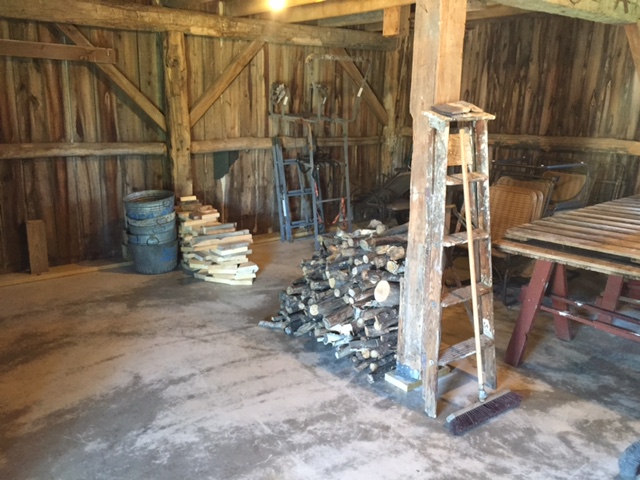
The barn remodeling is finished so everything that had been out in the yard under the tarps - tree stand, firewood, gardening stuff, fertilizer and collectibles was moved back in the barn today.
I'm feeling a bit bushed.
A place for everything and everything in its place:
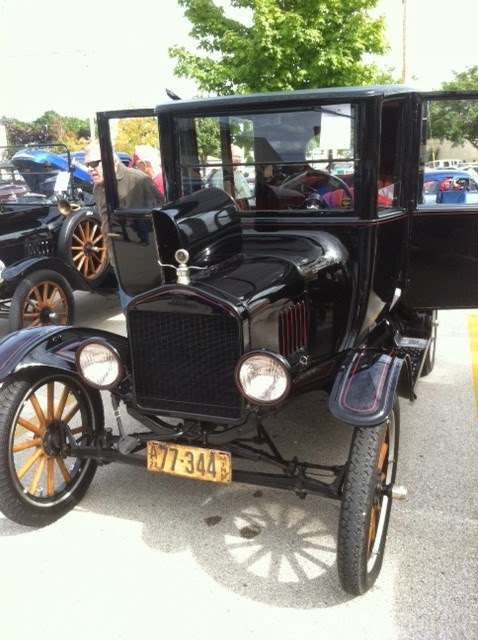
Yesterday brought the annual harvest festival and car show in Sturgeon Bay.
Met-up with brother-in-law and his Frau and enjoyed an adult beverage or two, lunch, classic and old cars along with a huge collection of hot rods and race cars. This is an annual event for me and every year I see more and more vehicles that I haven't seen before.
Hard to believe there are this many collector cars in northeast Wisconsin. Or maybe not. Here's sampling...
This old Willys sported four - count them - four gear shifters.
And this Corvair pick-up had a massive amount of space in the back for hauling.
I never knew that the Corvair line sported a pick-up version. The cargo box had a drop-down tailgate located in the rear and a big door that opened on the passenger side.
Among some of the most impressive of vehicles at the Sturgeon Bay auto show was a 1941 Buick Roadmaster. This pre-war vehicle sported an eight cylinder in-line motor.
Amazing.
You can learn more about how this thing worked here.






 Posts
Posts

