Showing posts with label Sunrise. Show all posts

Saturday, June 20, 2026

Summer Solstice

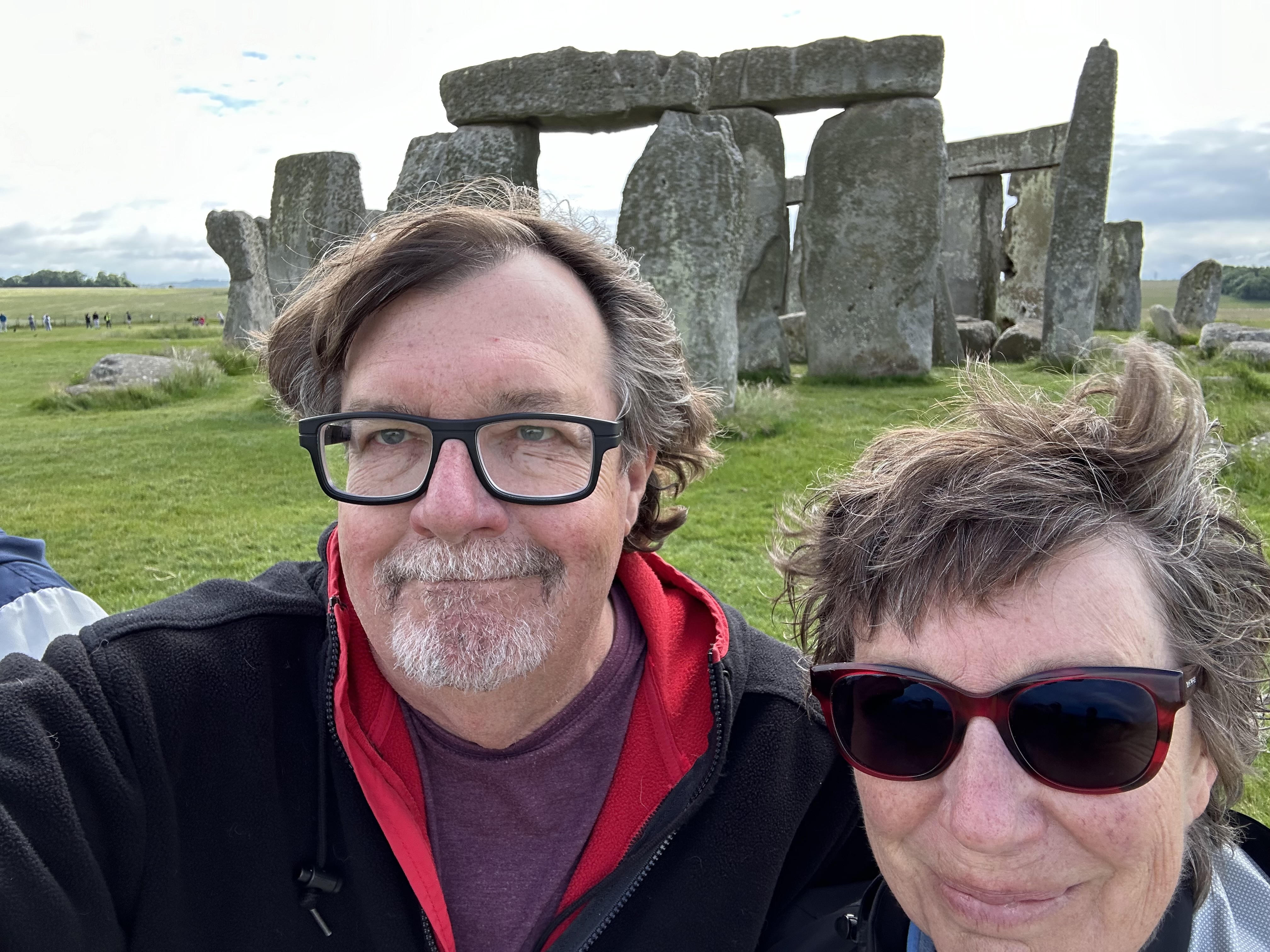
Solstice Stone - Stonehenge, UK

Tomorrow is the Summer Solstice here in the northern hemisphere which means that on Sunday we receive more sunlight than any other day of the year.  Naturally, you would conclude that this date would have the earliest sunrise and latest sunset, no?  

Don't jump to conclusions.  Even though the solstice has the greatest amount of daylight - the earliest sunrise occurs before the solstice and the latest sunset falls afterward.  The occurrence of those events is dependent upon how far you are from the equator – a function of the tilt of the Earth on its axis.  

Here is an interesting factoid – I went to the US Naval Observatory Astronomical Applications Department and looked-up the Sunrise and Sunset times for my location here at The Platz before, during and after the solstice. 

June 17 Sunrise 5:03 Am Sunset 8:38 PM
June 18 Sunrise 5:03 AM Sunset 8:38 PM
June 19 Sunrise 5:03 AM Sunset 8:38 PM
June 20 Sunrise 5:03 AM Sunset 8:39 PM
June 21 Sunrise 5:03 AM Sunset 8:39 PM
June 22 Sunrise 5:04 AM Sunset 8:39 PM
June 23 Sunrise 5:04 AM Sunset 8:40 PM
June 24 Sunrise 5:04 AM Sunset 8:40 PM
                                       June 25 Sunrise 5:04 AM Sunset 8:40 PM

Notice that the three dates preceding the solstice have almost the same amount of daylight.  The implication is that the solstice lasts more than half a week. 
 
What's the explanation?  Does it have something to do with our location being almost equidistant from the North Pole and Equator?  Or is it a consequence of rounding the precise times?
 
The notion that the solstice lasts for a few days or a week is a very common perception that even ancient astronomers noted.  But mechanically-speaking, it's a beautifully precise illusion caused by trigonometry and orbital mechanics.  
 
The earth orbits the sun in a smooth, continuous curve.  Because the earth is tilted on its axis by 23.5 degrees the angle of the sun relative to earth's equator (called solar declination) changes throughout the year.  If you plot this change on a graph over 365 days it forms a sine wave.
 
At the Equinoxes the curve is at its steepest.  The sun's position changing rapidly every day meaning you notice significant differences in daylight length from one week to the next.
 
At the solstices the curve reaches its absolute peak (or trough).  In calculus and trigonometry the top of the smooth curve has a slope of zero.  As the earth approaches this peak the daily rate of change slows to a crawl. 
 
During the days immediately preceding and following the solstice the difference in length of daylight is measured in seconds (not minutes); consequently, to our everyday clocks and senses it appears static.
 
While the "effect" of the solstice lingers for about a week, the astronomical event itself happens in a precise fraction of a second.  That exact moment is when the earth's axial tilt is inclined closest (or farthest) from the sun.  It is a single point in time occurring simultaneously for everyone on earth regardless of time zone.  For me that is June 21, 3.25 AM CDT.

Apologies for making your head hurt.

Thursday, May 21, 2026

Sunrise

Yesterday evening I posted a couple of photos of a peninsula sunset.

This afternoon I bring you a video of a peninsula sunrise.

And you though trail cameras were only for wildlife....


Tuesday, February 3, 2026

February Skies

Members of the Cherokee nation refer to this month’s full moon as the Bone Moon.  This was a consequence of depleted food stores and the necessity of cracking-open bones to access the marrow for survival food.

My own people – the ancient Celts – remember this as the Moon of Ice as it is associated with the coldest month of the year.   

Colloquially, the February full moon is the Snow Moon.

Simultaneous moonset and sunrise this morning.  A doubler.

View east...

View west...


And when you live halfway between the equator and the North Pole it’s still dang cold….


Thursday, October 30, 2025

Front to Back

A sunrise

And a sunset

When you live in flyover country the views over the horizon are generally pretty nice.... 

Thursday, June 19, 2025

What To See In The June Sky

There is an old saying about making hay while the sun shines - a recognition that farm chores last as long as there is daylight.  The last four weeks have been witness to my neighbors fetching their first cutting of hay; along with spreading manure, tilling, discing and planting.  It has been a busy place here in flyover country. 

We know that the summer solstice tomorrow marks the longest day of the year yet the latest sunset of 2025 doesn't occur on that date.  Let me explain.

Solstice Stone - Stonehenge, UK

The solstice marks the farthest point of advance in the sun's relentless march to the north, delivering the maximum daylight hours of the year for the Northern Hemisphere and the minimum daylight hours of the year for the Southern Hemisphere.  The solstice this month marks the beginning of summer here in the Northern Hemisphere and the winter in the Southern Hemisphere.  

The word solstice literally translates to: sun standing still.  Following this event the sun begins to march in the opposite direction and heads south with our daylight hours getting shorter.  Daylight will continue to dwindle until December 21 - The dark days of the winter solstice - and the first astronomical day of winter after which the process reverses and repeats itself.    

All of this aside, there is a curious paradox in play as a few evenings immediately following the solstice seemingly and inexplicably get brighter.  

If you were to check your Farmers' Almanac sunset tables on pages 150 and 151 you would note that at latitude 40 degrees north the sunset occurs at 8:33 every day from June 21st thru July 3rd.  On June 27th it will set a few seconds later compared to the 26th or 28th.  

What gives?

We all know that following the solstice the days grow shorter so logically the sun should be setting earlier, no?

Here in the northern hemisphere, where you live halfway between the equator and the north pole, on the 27th of June the sun will set just a few seconds later.  While this would seem to defy both logic and the science about days getting shorter; as a consequence of our elliptical orbit around the sun and the phenomenon astronomers call analemma the earth is several million miles farther from the sun and moving at the slowest speed around it. Which would explain the hiccup in the sun setting.

Most of you may not be making hay today; nevertheless, on Friday of next week enjoy a couple of extra seconds of sunlight as you take-in another sunset.

Cheers! 

Tuesday, April 22, 2025

The Magic Hour

Google Photo periodically furnishes unsolicited photo vignettes using their AI platform.  Like these brief, fleeting, moments associated with the rising and setting of the sun.

Characterized as the Magic Hour almost always these moments are not even close to an hour.  Most often they are there and gone in a heartbeat.  You snooze you lose.

This is nice slideshow....


Thursday, March 6, 2025

The Magic Hour

Google Photo periodically furnishes unsolicited photo vignettes using their AI platform.  Like these brief, fleeting, moments associated with the rising and setting of the sun.

Characterized as the Magic Hour almost always these moments are not even close to an hour.  Most often they are there and gone in a heartbeat.  You snooze you lose.

Nevertheless,they are a welcome addition to my day; especially travel photos set to music.


Monday, January 27, 2025

Winter Sunrise

Thirty minutes of sunrise unfolding.

Good morning, Monday….


Tuesday, January 21, 2025

Polar Vortex

As per usual I rose before sunrise, turned-up the heat, turned on the coffee, checked the indoor/outdoor temperatures (65/-14F), checked the Indoor/attached garage temperatures (64/34F), fed the dog and went out on the porch to check the sunrise.

I sure hope the worst of this polar vortex is going to be behind us in the 24 hours.

It's not fit for man nor beast out there.

Monday, January 20, 2025

Polar Vortex


Perfectly tropical -9F this morning.

Thankful for the sunshine streaming thru the windows as this passive solar does make a difference.


Wednesday, January 15, 2025

A Ray of Sunshine


If you rise early enough for breakfast then following a trip to the yard for a potty break you can stretch out on your dog bed and soak-up the morning sunshine.

It's a dog's Life.....


Tuesday, December 31, 2024

The Magic Hour

On this last day of the year it seem appropriate to share some highlights of those brief, fleeting, moments associated with the rising and setting of the sun.

Most always these moments are not even close to an hour.  Most often they are there and gone in a heartbeat.  You snooze you lose.

Happy New Year and thank you for reading, following and sharing.  See you next year on the flip side....


Thursday, November 28, 2024

Deer Camp

From the newest deer stand - daylight in the swamp...


Thursday, June 20, 2024

Happy Solstice

We returned from almost three weeks of family vacation in the UK last week.

While there, a visit to Stonehenge was in order.

No Druids were involved as this is both a Neolithic religious and astronomical site.

Happy Solstice, people!


Wednesday, June 19, 2024

Summer Solstice

Tomorrow is the Summer Solstice here in the northern hemisphere - 3:51 PM to be precise.  Which means that on Thursday we receive more sunlight than any other day of the year.  Naturally, you would conclude that this date would have the earliest sunrise and latest sunset, no?  

Don't jump to conclusions.  Even though the solstice has the greatest amount of daylight - the earliest sunrise occurs before the solstice and the latest sunset falls afterward.  The occurrence of those events is dependent upon how far you are from the equator – a function of the tilt of the Earth on its axis.  

Here is an interesting factoid – I went to the US Naval Observatory Astronomical Applications Department and looked-up the Sunrise and Sunset times for The Platz before, during and after the solstice.

June 17 Sunrise 4:03 Am Sunset 8:38 PM
June 18 Sunrise 5:03 AM Sunset 8:38 PM
June 19 Sunrise 5:03 AM Sunset 8:38 PM
June 20 Sunrise 5:04 AM Sunset 8:39 PM
June 21 Sunrise 5:04 AM Sunset 8:39 PM
June 22 Sunrise 5:04 AM Sunset 8:39 PM
June 23 Sunrise 5:04 AM Sunset 8:40 PM
June 24 Sunrise 5:04 AM Sunset 8:40 PM
June 25 Sunrise 5:05 AM Sunset 8:40 PM
 
Notice that the three dates preceding the solstice have almost the same amount of daylight.  The implication is that the solstice lasts more than half a week. 
 
What's the explanation?  Does it have something to do with our location being almost equidistant from the North Pole and Equator?  Or is it a consequence of rounding the precise times?  I think it is the latter rather than the former.
 
Nonetheless, any difference is the amount of daylight will not be discernible to this old guy’s eyes.


Tuesday, December 19, 2023

Sunrise

From last week a brilliant red sunrise.

Two days to the winter solstice!

Friday, December 15, 2023

Sunrise

Tuesday morning I rose before sunrise and put the coffee-on.  Looking out the kitchen window I saw the sun begin to peek above the southeastern horizon.  Taking a photo from the porch I cursed the utility pole despoiling the view.  But I digress.

I seems like it was only yesterday that the sun was rising over the machine shed immediately to the east.  Not so; Old Sol is continuing it's relentless march south as we approach the winter solstice next week. 

We live almost half-way between the equator and the north pole and with mostly clear horizons and dark skies astronomical events are easier for us.  Although as the forest continues to grow west of the house the view has shrunk over the last thirty years.

Anyway, I shot an azimuth with my compass for kicks and giggles.  And so you know I'm not making this up..... 


Wednesday, October 25, 2023

Wassup In the October Night Sky

Technically, the pre-dawn morning sky.  From 6 AM the other day there was this in the eastern horizon.  The morning star - the Light Bearer - planet Venus in the constellation Leo.  The glow is sunlight leaking into the the view from below the horizon.


Venus is Earth's closest planetary neighbor and the second planet from the Sun. Venus appears either in the eastern sky before sunrise or in the western sky after sunset. 

When it appears after sunset in the western sky, it is called an evening star.

Of course, there is always my pal Orion - steadfast in the southwest sky before sunrise.  The glow in the photo is light pollution from the city of Green Bay to the southwest.

It has occurred to me that I need to change things-up a bit.  And take the dog our back to pee in the morning.  At least then I'd see what the predawn sky looks like to the north.....

Wednesday, October 11, 2023

Ruby Sunrise

A week or so ago I woke up with my pupper and got situated on the porch.  It was dark and Orion was in the southern pre-dawn sky.


Dog piddled.

Army surplus fleece and a hot cup of joe for me.

Dog on my lap.

Checking my email and news feeds this sorta snuck-up on me to the east.

Coincidentally it matched the dog.

Almost missed it.....


Tuesday, October 10, 2023

Wassup In The October Night Sky

Super bright Venus is associated with the constellation Leo in the pre-dawn eastern horizon...