Showing posts with label Meteorology. Show all posts

Saturday, September 9, 2023

Changing Of The Seasons - Part Three

In the United States those of us that follow or study the weather we observe prefer to use meteorological seasons because fixed dates  allow for easier recording and comparison of weather and climate data.  The rest of the world tends to mark the astronomical seasons.

Which one you may prefer to use depends mostly-upon where you live.  According the the American Meteorological Society the hemispheres and coastal versus inland locations all play a role.  Thusly, for those of us who live in the northern hemisphere and are land-locked meteorological seasons are for frequently observed.  If you live in the southern hemisphere the impact of oceans plays a larger role on temperatures and weather.  Therefore, astronomical seasons are preferred.

Complicating this somewhat is the that, at least where I live, the earth has been warming following the retreat of the glaciers.  Only 10,000 years ago (a blink of an eye in geologic time) my location was buried beneath an ice sheet a mile thick.  So thick that the earth's crust continues to rebound from the weight of all that ice.

For those of us residing in the northern hemisphere a study in Geophysical Research Letters found that between 1952 and 2011(two generations) the seasons have shifted in length.  Winter has gone from 76 to 73 days, spring from 124 to 115 days, fall 87 to 82 days and summer from 78 to 95 days.  Yikes!

The same study implies that if the trend continues at the current rate by the time we get to 2100 summers could last about a half of an entire year while winters would shrink to only a couple of months.  Our seasons would look more like locations closer to the equator regardless of being arid or tropical.

I certainly won't be around to witness it if it happens but it's certainly interesting to ponder.

Thursday, September 7, 2023

Changing Of The Season - Part Two

One of these days I am going to visit Stonehenge - an ancient astronomical clock dating back to the era transitioning from the Neolithic Era to the Bronze Age.  Astronomical seasons have obviously been around for a long time and are based-upon our observations of the tilt of the earth on its axis as it orbits the sun over the course of a year.

For those of us that live in the northern hemisphere the season called summer begins with the summer solstice when we are tilted in the direction of the sun and on the receiving end of warming sunlight.  Actually, we begin to tilt away from the sun immediately following the summer solstice; but the earth continues to warm as air temperatures lag.  This is called solar irradiance.  (Word of the Day)

For those of us in the northern hemisphere the winter solstice is marked by the day earth's axis is tilted farthest away from the sun resulting in a dearth of sunlight. 


Astronomical fall and spring  are marked by a neutral tilt on earth's axis.  It is in these transition months that the autumnal equinox and vernal equinox occur.  An equinox (Latin word for Equal Night) marks the two times a year when our axis is not tilted toward or away from the sun.  The result is 12 hours of daylight and 12 hours of darkness on those dates.

Ordinarily, the earth transits around the sun over 365 days.  Sometimes it takes 366 days.  As a consequence of this the solstices and equinoxes can vary from one year to the next.  The vernal (spring) equinox is generally around March 20 with the summer solstice landing around June 20-21.  The autumnal (fall) equinox is generally around September 22 and the winter solstice landing around December 21-22.

Remember all of this as there will be an exam. 


Saturday, September 2, 2023

Changing Of The Seasons - Part One

Most of you readers already know that I habitually mark the relentless march of the sun on a seasonal basis.  In particular, where it sets on the western horizon.  It is this sunrise-to-sunset cycle that marks the passing of our days.

Our seasons similarly mark the passing of the year. And just like the passing of a day can be marked with a wrist watch the position of the sun our seasons can be marked either by the interrelationship between the Earth and Sun (astronomical) or by the change in weather (meteorological).  


Meteorological seasons are based-upon our observation of the fluctuating changes in temperature over the course of spring, summer, fall and winter.  For those of us who live in the northern hemisphere the warmest of seasons corresponds with the hottest months - June, July and August.  If you reside in the southern hemisphere it is the reverse - June, July and August are winter.

Spring and fall mark the transition between summer and winter.  March 1 thru May 31 bridges cooler to warmer temperatures.  And September 1  to November 30 bridges warmer to cooler temperatures.

Monday, January 11, 2021

Pogonip Redoux


The other morning brought more spectacular frozen fog.  

A product of overnight fog and freezing temperatures this rime ice is sometimes referred-to as radiation fog, valley fog or freezing fog.  It is also called pogonip – a Shoshone word for cloud.    

Ordinarily, fog materializes when there is cooler air coming in contact-with a warmer body of water or moist surface like a swamp or wetland. 


Freezing fog materializes when the air temperature is below freezing and the water droplets in the fog become super-cooled. These super-cooled water droplets stay in liquid state until they drift into contact with a surface they can freeze-to. Grass, twigs, trees, leaves and so-forth. 


From our walk we were quick to capture some images before the sun broke thru and burn it all away.....

Thursday, January 7, 2021

Return of the Pogonip

Following a random, unplanned day of sunshine on Tuesday, yesterday we woke to this.

Trees and grass ‘painted’ as if by Jack Frost himself.  


A product of overnight fog and freezing temperatures this rime ice is sometimes referred-to as radiation fog, valley fog or freezing fog.  It is also called pogonip – a Shoshone word for cloud.    

Ordinarily, fog materializes when there is cooler air coming in contact-with a warmer body of water or moist surface like a swamp or wetland. 

Freezing fog materializes when the air temperature is below freezing and the water droplets in the fog become super-cooled. These super-cooled water droplets stay in liquid state until they drift into contact with a surface they can freeze-to. Grass, twigs, trees, leaves and so-forth. 


It’s really a rather striking effect and pleasing to the eye. It is also something to be reckoned-with as it can result in ice build-up on roads – especially bridges – which have no ground insulation. It can also build-up on power lines with the result pf power outages. 

Drive carefully on mornings like this.

There will most surely be ice on the roads too..... 


Tuesday, January 5, 2021

Pogonip

The past week we’ve been waking to this……. 


Trees and grass ‘painted’ as if by Jack Frost himself.  It burns-off during the daylight hours and almost magically reappears from the overnight fogs. This winter meteorological event is a consequence of freezing fog.  Sometimes called radiation fog, valley fog or freezing fog it is also called pogonip – a Shoshone word for cloud. 

Fog materializes when there is cooler air coming in contact-with a warmer body of water or moist surface like a swamp or wetland. 

Freezing fog materializes when the air temperature is below freezing and the water droplets in the fog become super-cooled. These super-cooled water droplets stay in liquid state until they drift into contact with a surface they can freeze-to. Grass, twigs, trees, leaves and so-forth. 

It’s really a rather striking effect and pleasing to the eye. It is also something to be reckoned-with as it can result in ice build-up on roads – especially bridges – which have no ground insulation. It can also build-up on power lines with the result pf power outages. 

Drive carefully on mornings like this.

Or just stay-in and drink coffee. 


Sunday, July 16, 2017

Ominous Cloud Formation Explained


click on the pouches to enlarge

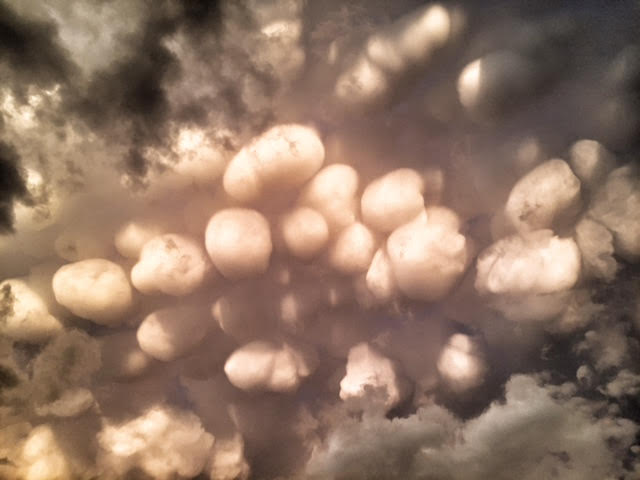
Remember that unusual cloud formation I posted yesterday?  My pal Six-Deuce saw it on Facebook and notified me that these are called Mammatus Clouds.  

They are pouch-like cloud structures and a rare example of clouds in sinking air. They are  also most often associated with anvil clouds and severe thunderstorms.   They often extend from the base of a cumulonimbus.  They usually form after the worst of a thunderstorm has passed.   

According to the University of Illinois the science is as follows:  Updrafts carry precipitation enriched air to the cloud top, upward momentum is lost and the air begins to spread out horizontally, becoming a part of the anvil cloud. Because of its high concentration of precipitation particles (ice crystals and water droplets), the saturated air is heavier than the surrounding air and sinks back towards the earth.   The temperature of the subsiding air increases as it descends. However, since heat energy is required to melt and evaporate the precipitation particles contained within the sinking air, the warming produced by the sinking motion is quickly used up in the evaporation of precipitation particles. If more energy is required for evaporation than is generated by the subsidence, the sinking air will be cooler than its surroundings and will continue to sink downward.   

Contrary to common knowledge they do not indicate an imminent tornado (although they do look ominous).  Mammatus can be a remarkable sight, especially when sunlight is reflected off of them.  Rare.  No wonder nobody has seen these before.  Cool.

Saturday, July 15, 2017

Potatoes in the Sky


A short-lived yet spectacular storm moved thru tonight at dusk.   

After the mayhem subsided the low-light conditions were conducive to a photo and I was finishing-up a panorama of the yard when afterwards I looked-up and saw this.  


click on image for a better view


Yikes!  

I have never seen cloud formations like this before.  It looks like spuds.  I emailed the pic to Brad Spakowitz who is the Weather-Guesser at WBAY in Green Bay. I'm hopeful he can ID them.  Maybe they'll even post it on tonight's news and I will be famous beyond meteorological measure...

Friday, May 8, 2015

Purple Haze

Purple sunset tonight.

click on image to enlarge

The color of the sunset has to do with the way light from the sun enters
the atmosphere. When the sun is overhead and the angle that the light
enters is small, the shortest wavelength light (violet and blue) are bent
slightly and are scattered by the air molecules and dust in the air to give
us a blue sky. If there is a lot of dust in the air, more light is
scattered making the sky appear less blue and sometimes even close to
white.


So where's all the dust coming from?

Spring planting.

Farm machinery is running day and night lately...

Tuesday, May 5, 2015

Contrails

Trail camera photo of my lovely Frau.

But what is stunning are the contrails in the sky above.

click on image to enlarge


Meteorological conditions were such that the usual commercial airliner traffic left a larger trail of larger, puffier and more persistent collection of contrails than usual. 

I should make a practice of looking up in the daytime sky more often...