Showing posts with label Logging. Show all posts

Saturday, March 21, 2026

Regeneration

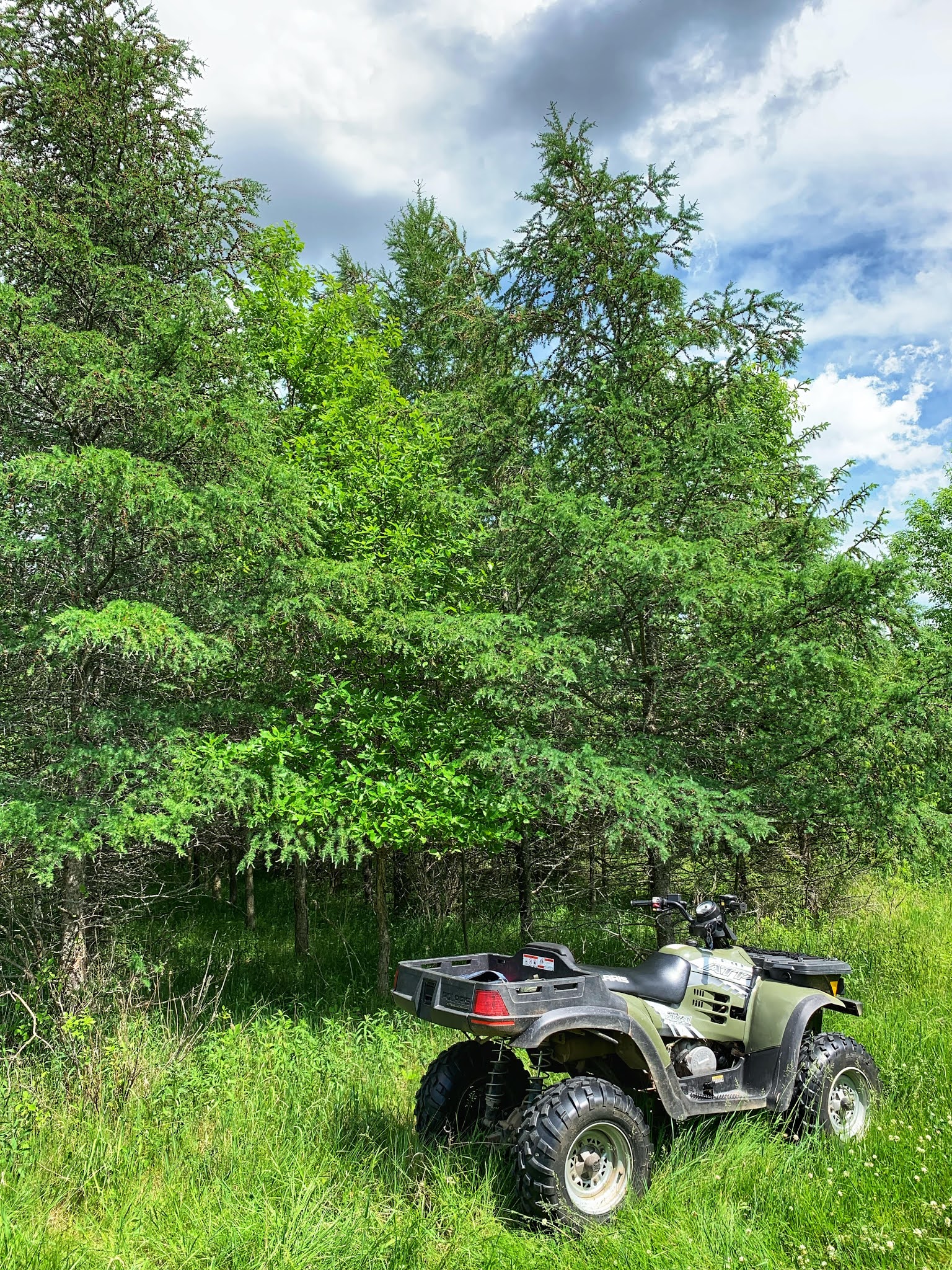
Last week doggo and I went out for a walk to see if we could find a forester in our woods.  No, we weren't playing Where's Waldo; I had gotten a text from a consulting forester we recently hired notifying me that on very short notice he was conducting a timber cruise.  You're probably thinking this has something to do with a luxury cruise ship or forest ocean liner.  For forestry purposes a timber cruise is a field survey conducted to measure, count and assess the quality, volume and species of standing timber for reasons of management, sales or tax purposes.  Inasmuch as we've not listed anything for sale this is strictly about updating our management plan going forward the next 25 years or so.

Doggo located our guy in short order and after an exchange of pleasantries we discussed past management practices and his professional first impression of what we got going-on in our built-from-scratch forest.

Some of you may recall that after acquiring our crappy piece of farmland in 1994 we decided to naturalize much of it by means of planting native cover - namely trees but also seven acres of pollinator habitat.  In 1998 and 1999 we planted roughly 40,000 native Wisconsin conifers and hardwoods.  For years I imagined I'd never live long enough to see those little seedlings ever amount to anything.  Lo and behold we woke-up one year and discovered we had a real forest on our hands.  It was so thick that in some locations you couldn't see through it, walk through it or even consider hunting it.  

So on the heels of the COVID shitshow we hired a logger to perform a pre-commercial thinning; a practice of removing less-desirable softwood conifers in order to release the more desirable and valuable hardwoods. A release is basically removing the competition so that the oaks had more access to sunlight and other resources.  

And I gotta tell you that opening-up the canopy accomplished two things.  First, the released trees put-on a huge growth spurt.  

Second, with sunlight reaching the understory Ma Nature allowed all manner if little seedlings to sprout and all of a sudden we had thousands of tiny little trees popping-up all over the place.


Naturally, the deer, rabbits and mice eat the tastier oaks, white pine and cedar but as a general rule turn-up their nose at tamarack and spruce.  That doesn't mean there's no regeneration of the former, just less.  And with the exception of something we might stick in the yard we're out of the business of planting trees.  Done!  Nature has assumed responsibility for the process going forward.  If you disregard the original investment in preparation and nursery stock, years of work, capital investment in equipment and time; all of these little trees are free for nuth'n. 


And an updated management plan will inform our actions going forward and serve as a guide to any future owners.

Next step is to hire a surveyor and actually determine where the property lines and corners actually are located.

Stay-tuned.....    

Sunday, May 18, 2025

Long Road To Get Here

Fourteen years ago I published a short observation of Wisconsin's efforts to measure if the Emerald Ash Borer had spread To the Peninsula.  Inevitably, it did and the work of this non-native pest has left its mark.  The landscape is now covered with dead and dying ash trees.

The Emerald Ash Borer (EAB) kills ash trees by feeding on the tree's inner bark, disrupting the flow of essential nutrients and water. The larvae tunnel under the bark, creating "S"-shaped galleries and weakening the tree's ability to transport resources to its leaves and roots. Over time, this damage can lead to canopy thinning, branch dieback, and ultimately, death.

All of our mature ash trees are toast although just as with the elm species considered extirpated three generations ago natural regeneration persists, plenty of ash seedling continue to sprout in the forest understory.  So, maybe there is hope.  We dodged a bullet as the trees we planted decades ago were a mixed bag of native Wisconsin conifers and hardwoods.  Yes, the ash is dead or on life-support depending-upon how you view the situation but most everything else is thriving.  Meanwhile, some of my neighbors have woodlots dominated by ash and it breaks one's heart to drive by it on a regular basis.

Recently we hired a contractor to remove the dead ash from immediately around the house and all the dead trees on our side of the county road that posed a threat of toppling-over, landing in the road thus creating a hazard to vehicular traffic.

A crew of four, mechanized equipment; it took a day and a half.

From around the house, most of the logs were removed, smaller trees and the slash were chipped.  Along a quarter mile of road everything was dragged aside and left in the woods.  I have more firewood now if I'm inclined to cut it, split it and fetch it.   And boy has the view from the porch changed!


Monday, October 4, 2021

2021 Logging - Part 5

Saturday I received a text from Frank the logging company guy with a heads-up that he was planning to begin removing bolts harvested in June of this year.

Yesterday I discerned the audible noise of heavy machinery to the north - so I decided to slip-on my raincoat, rubber boots, phone and trail camera stuff to go take a look.  It was likely Frank and if not I could at least check the trail camera trap line in the process.

Yup, Frank.


And I continue to be amazed at how modern logging practices are primarily a one man operation at almost each and every step of the way.

I also uploaded some really nice digital photos and videos making the trip.  Stay-tuned for more on that before too long.

Note:  The rapid, single digit background chattering is the motor on the four-wheeler.

Sunday, July 11, 2021

2021 Logging - Part 4

This machine - again operated by a single individual - is a 'Forwarder'.  


This is a forestry vehicle that can load and transport logs by itself. It has the unique capability of picking up logs on the site and loading its trailer bed for easy transportation for stacking at the 'Landing'.         

Manned by one operator it is used to fetch and load bolts from the logging operation and deliver and stack them at the ‘landing’.     

Amazing to my eyes how logging has become mechanized to such an extent that it has become virtually a one person operation.        

There is also a stack of 8-9 cords of ash bolts for our own personal use as firewood to supplement our winter heating and outdoor wood-fired oven needs.      

There is most definitely a log splitter in our future……


Wednesday, July 7, 2021

2021 Logging - Part 3

Anyway, most of the north end has been cleared and next week a machine called a 'forwarder' will pick-up, load and deliver to the 'landing' the bolts harvested from the logging operation.     

I spoke with Luke yesterday and asked that the middle and southern-most plantations will also get a touch-up thinning but nothing on the order of the scale of the project in the northernmost stand. As long as the equipment is mobilized it's time and materials so to speak.            

Jill and I took the Mule out a short while ago to check on the progress to the north.  The main takeaways are as follows:

  1. There is now beaucoup sunlight busting thru the canopy. Absolutely unbelievable. Forest regeneration should take-off big time on the coming years.

  2. We had no clue how tall the remaining trees actually are - in many cases far-taller than 100 feet. A logger with a good eye for dominant trees favors taking the runts and leaving behind the best in class - pine and hardwood.

  3. The hunting dynamic will obviously change this fall. It's too early to say for precisely how but opening this up will absolutely affect deer movement and shot opportunities.

  4. The later model iPhones include a built-in stabilizer for shooting video on surface where you are bouncing-around climbing over 8-9 inch pulp bolts strewn in the trail. You'd never know it from watching the video. View is looking east from the central trail as we travel north to the property line at Dump Road

Stay-tuned for more updates....…


Saturday, July 3, 2021

2021 Logging - Part 2

An update on the logging operation that was commenced on our forest to thin most (but not all) of the conifers so as to provide the more valuable hardwoods (namely oaks) an opportunity to put on additional girth and height having been rid of the pines that were competing with them for precious resources like water and sunlight.  Hardly random - the trees had previously been marked for removal.  In technical forestry terms this pre-commercial thinning is called a 'release'.       

This machine is called a 'harvester'.  It is operated by one individual.

The machine grabs a tree, saws-it-off at the base, flips it 90 degrees, and zips it into three bolts while removing the bark and limbs. Left on the forest floor is slash.      


Luke - the guy operating the harvester - can process two trees a minute. Which makes you pause and ponder the relative merits of felling trees with a chainsaw. One at a time. On your own.            


To the casual observer this may look a fright. My neighbor (and fellow tree aficionado) remarked the other day that opening the canopy is going to provide the hardwoods with an opportunity to really put on some height and girth all the while allowing spruce, tamarack, pine and cedar the opportunity to naturally regenerate in what had previously been a darkened understory.              

This is making my week. Exciting stuff.....


Tuesday, June 29, 2021

2021 Logging - Part 1

After three years of searching for a logger we've finally been able to pull it off.  A thinning of the forest we planted more than a couple of decades ago.       

We planted more than 40,000 trees on marginal farmland over the course of 1998 and 1999. The trees pictured here were planted in June of 1998. They were one and two year-old bare root stock making them about the size of a pencil. It's a mixed bag of native Wisconsin hardwoods and conifers.         

Machine planted in alternate rows it was the job of the bushier softwood conifers to 'train' the hardwoods to grow with nice straight trunks.

It is a successful planting - so successful that the forest had become virtually impenetrable and over-stocked with the conifers beginning to crowd-out and compete with the more valuable hardwoods for space and resources such as water and sunlight.    

It was time for them to go.     

This management technique (called a pre-commercial thinning) removes most (but not all) of the conifers so as to 'release' the hardwoods.  I blogged about this process more than a couple of years ago.     

Without having to compete with other trees we expect the oaks to literally WHOOSH with a flush of new growth. And in the years to come any scrawny less desirable hardwoods can be dropped for firewood or other similar uses allowing the dominant specimens even more room to grow.   

By then this planting will have become an acorn factory providing food and cover for the local critters.         

And, of course, there remain enough conifers to serve in the role of 'seed trees' so that natural forest regeneration will continue in the decades to come long after this old man is pushing-up daffodils.       

And so it begins.....