Showing posts with label American Manufacturing. Show all posts

Friday, January 23, 2026

On This Day In History

During World War II a class of small coastal and inter-island freighters were constructed  for the Army Transportation Corps.  This was a steel-hulled, diesel-powered ship, 177 feet in length and equipped with two hatches and central booms.  On April 16, 1944, Kewaunee Shipbuilding and Engineering Corporation launched a small coastal freighter at its yard in Kewaunee, Wisconsin. She was originally designated FP-344, but that was later changed to FS-344.  

click on images for a closer look

Photo above is fitting out of FP-344 at the Kewaunee Shipbuilding & Engineering Corp. Shipyard, Kewaunee, Wisconsin circa July 1944. 

Photo below is her sister ship FP-343 underway.

In 1966 FS-344 was transferred to the Navy and renamed USS PUEBLO.  Refitted at the Puget Sound Naval Shipyard she was crammed with sophisticated electronic gear and converted to an Auxiliary General Environmental Research (AGER) vessel – a class recognized by few naval officers.  PUEBLO (AGER-2) was a signals intelligence collector – a spy ship.  Jointly operated by the National Security Agency and Naval Intelligence, she carried a crew of 83, 30 of whom were communication technicians.

PUEBLO’s first mission, off the coast of North Korea, was considered low risk. She was to monitor electronic transmissions and observe naval activity around North Korean ports. Orders required her to remain in international waters at least one mile beyond the 12-mile territorial limit. Thus far the North Koreans had not interfered with similar missions.

However, on January 23, 1968, North Korean patrol boats surrounded PUEBLO intent on capturing the lightly armed vessel.  With a top speed of 13 knots, she could not escape. Her captain could only stall for time as the crew worked furiously to destroy documents and equipment. Despite urgent requests, neither the Navy nor Air Force sent help. After about two hours, the North Koreans were able to board PUEBLO.  One crewman lay dying and several were injured.

The North Koreans took their prize to the port city of Wonsan. The crew was taken prisoner. They were beaten and tortured. 

President Johnson considered and rejected a military response. He was unwilling to sacrifice the crew. So their release was negotiated. 

The USS PUEBLO was never returned. It is currently on display at the Victorious War Museum in Pyongyang, North Korea. However, she remains a commissioned vessel in the U.S. Navy.  Commissioned May 13, 1967, PUEBLO is the second oldest in the fleet behind only the USS CONSTITUTION, commissioned October 1, 1797.

Kewaunee Shipbuilding stopped building boats when the war ended.  It did continue doing steel fabrication work.  The company changed its name to Kewaunee Engineering on January 1, 1947.  Oshkosh Truck acquired the business in1999.  What began as the Kewaunee Shipbuilding and Engineering Company is now Kewaunee Fabrications and operates as a subsidiary of Oshkosh Corporation.

Detailed story linked here. 

Sunday, August 10, 2025

Tariff Impacts Auto Industry

Import duties subtracted $800 million from Ford’s profit in the second quarter, leading to a slight loss for the period. For the whole year, Ford estimated that tariffs would cost the company $2 billion.

General Motors, the largest U.S. carmaker, said last month that tariffs would cost the company as much as $5 billion for the full year, although it hoped to offset about a third of that amount by cutting costs and moving some manufacturing to the United States. Still, the company expects retail prices to rise 1 percent or less this year, Paul Jacobson, the chief financial officer of G.M., told investors last month.

Toyota, which makes many cars in the United States but also imports them from Japan, Mexico and Canada, said on Thursday that tariffs would cost it $9.5 billion. A day earlier, Honda pegged its tariff cost at $3 billion.

No one has adequately explained why the tariff tax policy is even minimally beneficial or necessary in replacing the proven track record of free trade of the last 75 years. 

Anyway, import taxes are causing billions of dollars of losses.  According to Cox Automotive, as of mid-July carmakers had 82 days of supply in the United States, roughly enough to last until the beginning of October. That gives you a rough idea of how long they can avoid raising prices. 

You can read more about this here - no paywall either.  You're welcome..... 


Tuesday, July 29, 2025

Picking Winners and Losers - Part 2

Who’s winning?

Domestic US automobile manufacturers are subject to a 50% tariff on steel - resulting in the highest steel prices on the planet, a 25% tariff on parts imported from Mexico and Canada along with a 65%+ tariff on Chinese LCDs and electronics. 

The European Union can manufacture cars with zero steel tariffs, 4% Chinese tariffs, and zero tariffs on imports from Mexico and Canada. 

EU auto exports to the US are subject to a 15% tariff.

The Art of the Deal.......

Picking Winners and Losers

I'm feeling pretty good about front-running the most serious impact of tariffs on our household economics.   New appliances, vehicles, water heater, laptop, tablet, iPhone, including locking-down the pricing of a steel roof on the house eighteen months ago.  

I know I sound like a broken record but contrary to what White House Press Secretary Karoline Leavitt or Commerce Secretary Howard Lutnick will tell you about other countries paying the tariffs they're not playing it straight.  Tariffs (sometimes called a duty) are a tax on imports.  Tariffs are not paid by the other countries.  They are paid by the US importer.  The importer might "eat" some of the tax but because they have to turn a profit they generally pass it on to the purchaser of the imported goods.  

Tariffs are a tax (just like a sales tax) paid by US companies and consumers. 

Which leads me to this tidbit.

American-made steel is now the most expensive steel on the planet.

Only about twenty percent of the steel sold domestically is imported.  The steel tariffs, previously at 25%, were raised last month to 50%.  Consequently, steel imports became more expensive.  Naturally, imported steel has declined in volume allowing American companies to increase their market share and raise prices to match that of imported steel.

Domestic trade policy has created an opportunistic landscape that allows domestic producers to simply charge more.  Why, you ask?  

Because they can.  

Scott Lincicome, vice president for trade policy at the Cato Institute said it well - It's just pure protectionism and cronyism

Heretofore, president Trump has not imposed tariffs on imports of raw materials such as iron ore, pig iron and other products that are precursors to steel production.  Nevertheless, that could change if he imposes a threatened fifty percent tariff on all imports from Brazil.

In a fit of pique Trump has accused Brazilian leadership of conducting a witch hunt against his pal former far-right President Jair Bolsonaro; menacing the South American country with a retaliatory tariff over internal politics.  This personal retribution against Brazil means American consumers would pay more for coffee, orange juice, paper and pulp and steel precursors sold to American mills. 

White House trade policy is bananas.  Does any of this come as a surprise to you?

This is called picking winners and losers.  And it seems like all of my previously, self-identified libertarian friends have gone silent.

Meanwhile, I'm having a tough time figuring-out how any of this improves your and my prosperity and general lot in life.  And maybe make the world a safer place.

Wednesday, May 28, 2025

Out With The Old - In With The New

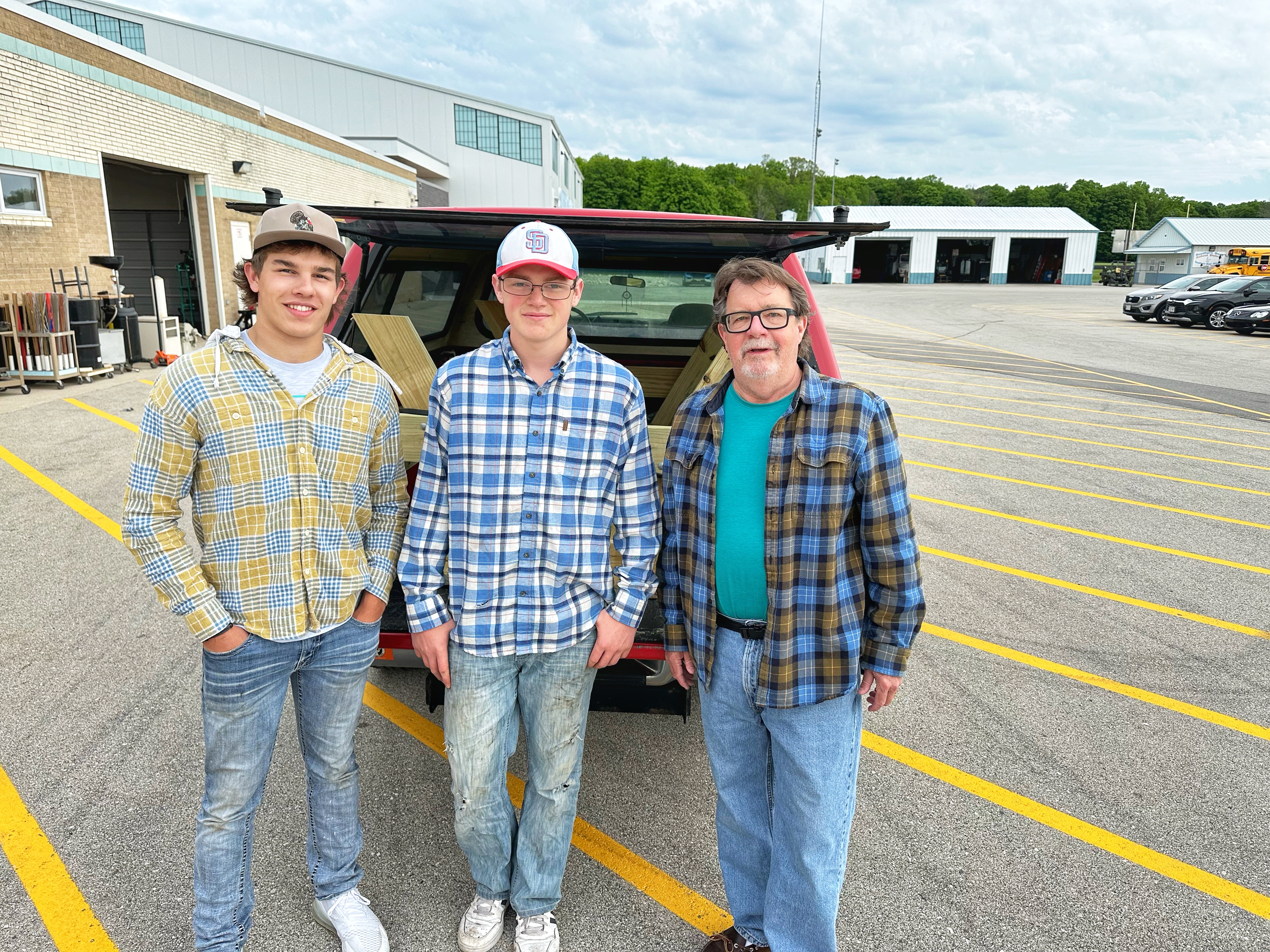
Yesterday’s voicemail brought the news that my new picnic table was ready for pickup.

This morning I went over to the high school where a bunch of freshly assembled picnic tables were waiting at Door 15 and the kids loaded one into the back of the pickup. 


The gnarly, 31 year old table in the background, is gonna return to the campsite where it originally lived. 

New table set me back $200.  
Solid construction too.  Southern Door industrial arts program rocks!

Sunday, March 9, 2025

Tariff Fatigue

Depending on various factors, opening an automobile assembly plant typically takes 2 to 5 years.  
 
Here’s a breakdown of the timeline:
 
1. Planning & Site Selection (6 months – 2 years)
Finding a suitable location
• Negotiating land acquisition and incentives
• Conducting feasibility studies and regulatory approvals
 
2. Design & Permitting (6 months – 1 year)
• Designing the plant layout and infrastructure
• Obtaining environmental and construction permits
 
3. Construction & Facility Setup (1 – 2 years)
• Building the factory, utilities, and support structures
• Installing assembly lines, robotics, and automation systems
 
4. Hiring & Workforce Training (6 months – 1 year)
• Recruiting workers and management
• Training employees on assembly processes and safety protocols
 
5. Testing & Production Ramp-up (6 months – 1 year)
• Testing machinery, refining processes, and ensuring quality control
• Gradually increasing production to full capacity
 
Factors That Can Affect the Timeline:
 
• Government approvals and incentives
• Supply chain readiness and equipment availability
• Labor market and workforce training needs
• Complexity of the vehicles being produced
 
Consider this; Tesla’s Gigafactories typically take 1.5 to 2 years, while traditional automakers can take 3 to 5 years to fully operationalize a new plant.
 
The bottom line is this is exceedingly complex and expensive.  It is not easy.  
 
Last week we were witness to serious stock market volatility following the President's announcement that tariffs would go into effect on all automobiles manufactured outside of our borders.  We can argue all day long about who should have seen this coming; but the markets don't like tariffs.  Nonetheless, it looks like Howard Lutnick, former head of Cantor Fitzgerald, who is a moderate on trade and is now commerce secretary may have gotten the ear of President Trump.  
 
One of the endearing qualities of Donald Trump is his fascination with the stock market as a barometer of his success.  Consequently, the White House has paused tariffs on automobiles assembled in Mexico and Canada for 30 days so that Ford, General Motors and Stellantis can produce their plan for re-shoring all of the manufacturing and assembly to the US.   As White House Press Secretary Karoline Leavitt put it:  Get on it., start investing, start moving, shift production here to the United States of America, where they will pay no tariffs.
 
This is easier said than done because in the many decades that have passed since the North American free trade zone was created in 1992 automakers have built complex supply chains that cross multiple borders.
 
You're probably scratching your head and wondering what the heck.  It's not rocket science. Manufacturers achieve economies of scale by means of multiple large plants both here and abroad to supply assembly operations across North America* with stuff like engines, EV batteries and motors, transmissions, suspensions, body panels, seats and wiring harnesses.  Everything that is required to build an automobile.  I couple of years ago a handful of us got a tour of a Volkswagen assembly plant located in Dresden, Germany.  This is not unique to North America.
 
The brilliance of this manufacturing model is vehicles would be less affordable if all of their component parts had to be made in one country.    

In our household we have two newer vehicles.  A Ford Mustang Mach-E; assembled in Cuautitlan, Mexico with parts sourced in Europe and North America.  In December we purchased a Honda CR-V Hybrid; assembled in Greensburg, Indiana with parts sourced in Japan and North America.  We still have our trusty 1998 Chevy Silverado.  It was assembled in Pontiac, Michigan with parts sourced in North America.
 
A vehicle is considered an import when it is shipped to the states after final assembly in another country.  Factually, because of the complexity of supply chains nowadays it is almost next to impossible to tell an American car from and import by simply looking at the brand.
 
With the exception of the Great Recession and COVID; over the past couple of decades the annual number of imported vehicles sold in the US has consistently hovered around 8 million units.  Countries of origin, ranked from high to low are as follows:  Mexico, Japan, South Korea and Canada.  Domestic production peaked at 13 million units in 1999, fell during the Great Recession and rebounded to 12 million as consumer confidence returned.  Annual production since has been 10.6 to 11 million units.

As a recovering financial guy and erstwhile observer of all of the drama my take goes something like this:
  • The threat of tariffs appears to be real.  Is Trump bluffing?  Or is he willing to kill the hostages?  Who is the angel and devil sitting on his shoulders?
  • Last month, Ford CEO Jim Farley warned that 25% tariffs on Mexico and Canada would blow a hole in the US auto industry; the largest manufacturing contributor to domestic GDP.
  • Moving everything to here is disruptive and would unnecessarily hobble the US auto industry.  Besides, it has the stink of Soviet central planning and government meddling with business all over it.
  • US automakers built their business models around government trade agreements; NAFTA (Clinton) and USMCA (Trump).  Commencing the undoing of more than thirty years of sophisticated business in thirty days is complicated and expensive.  It is not easy.  Much of it would be unfinished when Trump leaves office in four years.
  • There is that nagging likelihood of negative first quarter GDP.  The growing polarization of Elon Musk, falling consumer confidence, no budget reconciliation (yet), a looming debt ceiling and threat of government shutdown and the chaotically messy on-again, off-again policy messaging from the White House.  Business and markets abhor uncertainty.  
  •  Trump is sensitive to market volatility, drops in particular.  He's also sensitive to polling of his approval rating.
  • Finally, there is this immutable Rule of Thumb:  two consecutive quarters of negative GDP growth = Recession. 
We shall see what we shall see.......

*North America includes Canada, Mexico and United States


Wednesday, August 26, 2020

Takes a Beating - Keeps On Cooking

Founded by William Coleman this company is known for producing a wide variety of camping and recreational use products. The first dating back to 1900 – the gasoline pressure lamp. 

The first pressurized gasoline camp stove was introduced in 1954 – the Model 413E. This variation was sold from 1954 thru 1961.  As a child I recall camping with mom and dad out of our venerable American Motors Rambler station wagon. Lacking a tent mom and dad bunked in the back of the wagon and I slept on the front seat. Dad hand-built screens to insert in the open windows for ventilation. Mom cooked on a borrowed and battered Coleman gasoline camp stove and I’d bet it was the first model 413E. 

I have pictures in my possession somewhere but I digress. 

In any event I brought these up out the basement last weekend thinking they might get some use this fall/winter. 

These are called Coleman Suitcase Camp Stoves. The smaller on top is a Model 425E manufactured January 1967. I purchased it used. The larger on on the bottom is a Model 413G manufactured April 1980. I purchased it new at Fleet Farm. 

They’re both two-burner models with the smaller stove capable of 14,000 BTU output on the main burner. If the secondary burner is engaged the output is 7500 BTU on the right and 6500 BTU on the left. The larger 413G replaced the 425E and not only boasts an output of 17,000 BTU (9,000 right and 8,000 left) but has a stronger grate capable of supporting heaver cast iron cookware. 

Both of these stoves have surface rust, dings and dents and plenty of scorching.  A camp patina I suppose. And they’ve cooked countless meals outdoors under a year-round range of conditions in both Canada and the United States. If only they could talk. 

I added some fresh gas and after tightening a loose fitting or two they both operate like champs. 

Manufactured in Wichita Kansas, USA - after 93 combined years of service – I figure the amortized cost per use is pretty small.

The lesson is:  hang-on to the good stuff - you never know when it might get put to use for a camping experience - or an emergency.