Showing posts with label Native Plants. Show all posts

Sunday, November 16, 2025

Ramps

Allium tricoccum - wild leek or ramp.  The leaves and bulbs are used in cooking, pickling, seasoning, salads and much, much more.  When we had our trailer home in the woods many years ago there was a patch of these growing beside our shed; a handy source of wild onion.

They're found in the rich, moist soil of deciduous woods ranging from southern Canada to Appalachia.  Commonly  fried-up with potatoes in bacon fat or scrambled eggs served with beans and cornbread they are a tasty, and renewable wild edible used in place of onions and garlic.

So I decided to plant some in my woods as an experiment - a dozen bulbs in four locations along with an ounce of seeds for good measure.  I think the location is perfect and I hope the critters don't eat the bulbs.  The seeds will will scarify over winter during the freeze-thaw cycle and with a bit of luck many will germinate.  I marked the four locations with fluorescent flag tape so I can check on progress.  Fingers- crossed.


The white object in the center of the photo (above) is the tip of a planted bulb.

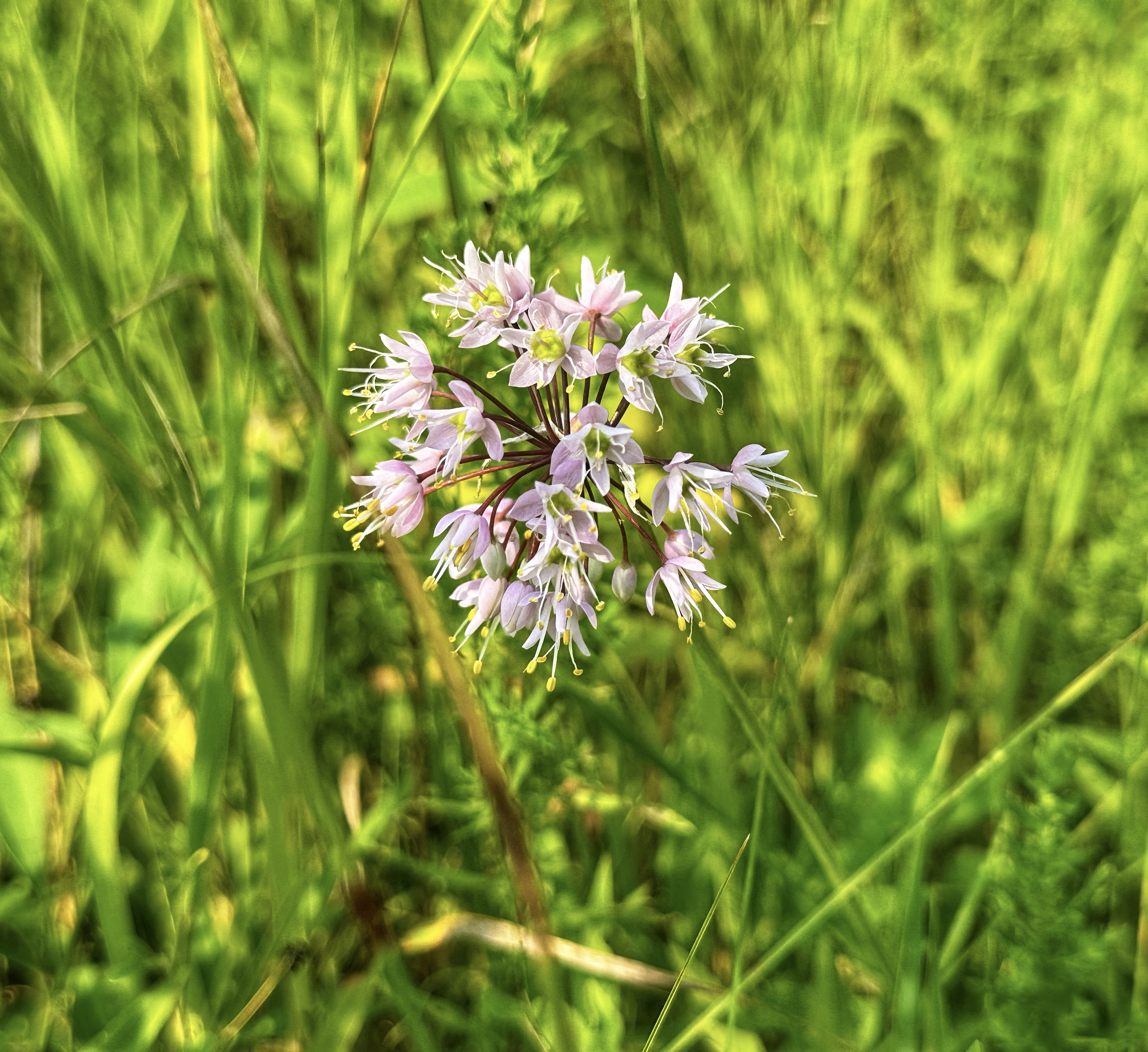
We have some nodding-pink onion (another wild allium) growing in the wetter locations of our pollinator habitat.  If this planting takes-hold I can always add more.  It would be nice to have more wild onion foraging choices.


Saturday, September 27, 2025

Fall Fireworks

Monday marked the astronomical arrival of fall.

From our walk the other day the asters have exploded like fireworks.


Further evidence of autumn.... 

Friday, September 19, 2025

ACHOO!

From our walk today there was this... 

Meet Helenium autumnale - named after Helen of Troy and the autumn time of the blooms.  It is commonly knows as Sneezeweed.


It is not a weed - it is a member of the vast family of Asters (Asteraceae).

It begins blooming late summer and persists into the fall with sometimes as many a 100+ flowers on each plant.  Multiply that by many multiple plants and it puts on a stunning display of blooms.

It grows all over around here preferring the wetter clay soils.  We didn't plant any of it but there are ginormous clumps of it growing around the rain garden pond so maybe the seeds came in with the ducks.  That's anybody's guess.

The deer appear to avoid it so if anyone wants to propagate it in their yard come by this fall to shoot some deer and collect seeds.  It is a maintenance-free and lovely flowering native plant.

Here's a historic tidbit about this plant that you can use to amuse and impress your friends.  Back in the day the early settlers collected the leaves and flower petals of this plant, set them aside to dry and pulverized it into a powder that was utilized as snuff.  

Hence the sneeze.

Saturday, September 13, 2025

Late Summer Blooms


From our walk there is this. 

Prairie Dock - Silphium terebinthinaceum.  Also commonly called rosin weed.  It is a sunflower-like plant it can grow to a height of 9 feet. With a 14 foot tap root it is exceedingly drought-resistant and can flourish for decades. 

The plant gets the name rosin weed because it produces a sweet-smelling resin when injured. While Prairie Rosin weed is the correct name for this specific plant, there are other plants called rosin weed that are different species within the same genus, Silphium. 

It is just now beginning to come on-line and pollinators are attracted to it as it blooms for more than a month. Birds love the seeds.

When we planted our prairie 20 years ago this species was not in the seed mix.  Like several other species it has found its way here and established itself on its own.

Bonus! 


Monday, September 8, 2025

Late Pollinator

 
From our walk I am pleased to report that the Indiangrass is flowering.

Yes, grass does bloom.

One of the earliest warm season grasses to set seed, this prairie tall grass forms upright clumps with blue-green summer foliage that turns gold in the fall.

It is tolerant of a wide range of soils including the crappy heavy clay soils around these parts. 

Many species of grasshoppers and caterpillars feed on Sorghastrum nutans.  In turn,  these insects are important food sources for upland game birds and song birds, where they will also find ideal nesting habitat in stands of tall prairie grasses such as this.
 

Wednesday, September 3, 2025

Late Summer Blooms

From our walk there was white turtlehead (Chelone glabra) is a native perennial wildflower known for its distinctive white, two-lipped flowers that resemble a turtle's head. It thrives in moist to wet soils, such as those found in swamps, stream banks, and rain gardens, and prefers full sun to partial shade. This plant is a valuable host for the Baltimore Checkerspot butterfly and attracts pollinators like bumblebees and hummingbirds.


Sunday, August 24, 2025

Blooms Butterflies and Bees

Meet Vernonia noveboracensiscommonly known as Ironweed.  It caught my eye while out bushwhacking trails and wildlife openings the other day.  It seemed a bit too early for New England Asters so I thought I better check it out.  

It is indeed a striking purple color and hard to miss.  It is a perennial native east of the Mississippi ranging from Massachusetts to Florida.  It belongs to the Asteraceae (sunflower) family and this specimen was north of four feet tall.  We didn't plant it but we're tickled to welcome it as butterflies and bees love it. 

The butterfly in your image is a 
Great Spangled Fritillary - Speyeria cybele.  It is a large, orange-brown butterflies with distinctive black markings on their upper wings. The undersides of their hind wings feature numerous large, silvery-white spots, giving them their "spangled" name.

They're commonly found in open woodlands, meadows, fields, and along roadsides across much of North America, including Wisconsin.  Adults feed primarily on nectar from various wildflowers, including milkweeds, thistles, and ironweed.  Their caterpillars feed on violet leaves - commonly found growing throughout the farm but primarily in the floodplain of Silver Creek.


Friday, August 22, 2025

Summer Blooms And A Bonus

From our walk yesterday morning it was much warmer.  Nevertheless, there was Great Blue Lobelia, bumblebees on Joe Pye Weed and Pileated Woodpecker wood working.  They'll keep at it until they disassemble that snag.


Trails and wildlife openings are complete! 


Thursday, August 21, 2025

Summer Blooms

It's gotten cooler the last couple of days and we've been delighted to turn-off the AC, open some windows and spend time outdoors for fresh air, exercise and chores.

From our walk yesterday morning there is stiff goldenrod, wild bergamot (bee balm), black-eyed Susans and flowering turkey foot (big bluestem)….


Thursday, July 31, 2025

Wildflower Blooms

From our morning walk the other day there were these showy, native flowers.

Bee Balm

Black-Eyed Susan

Blue Vervain

Compass Plant

Gray-Headed Coneflower

Joe Pye Weed

Obedient Plant

Prairie Blazing Star

Purple Coneflower 

Purple Prairie Clover

Tuesday, July 8, 2025

Wildflower Blooms

Several years ago we reduced the size of our turf grass in the yard and seeded a bunch of native plants. It takes several years for these plants to establish themselves and we just noticed, yesterday afternoon, that the ‘upland’ location (where the ancient farmhouse foundation is buried) is putting-on its own fireworks display. 
 
I figure as summer progresses more are going to pop. 
 
Here's what we got blooming so-far.  
 
Bee Balm (Wild Bergamot), Black-Eyed Susan, False Sunflower (Ox Eye), Motherwort, Pale Purple Coneflower and Feverfew (Wild Quinine).


Thursday, July 3, 2025

Wildflower Blooms

Spring has been cooler and late this year; consequently this forb is about 2 to 3 weeks delayed.  From our walk this morning there was Penstemon digitalis - commonly known as Smooth Penstemon.

A member of the snapdragon family this showy native to the prairie is also called foxglove or beardtongue.  Native Americans and folk-healers have made use of this plant for medicinal purposes for both people and animals.   

On our pollinator habitat this is the first species to materialize in large quantities.  And there is an abundance of this blooming beauty. Acres upon acres of the stuff.  This flower appears during late spring or early summer for about a month and then it’s gone.  


Long-tongued bees, including honeybees, bumblebees, miner bees, butterflies, Sphinx moths, and hummingbirds favor this plant.  The name Beardtongue is a consequence of the hairy reproductive parts found within the flower.

Saturday, June 21, 2025

Messenger of the Gods

Iris is the name of the Greek goddess of the rainbow – who also happens to be the messenger of the gods. 
 
This name can also be given in reference to the word (which derives from the same Greek/modern Latin source) for the colored part of the eye and the flower.
 
 
From our walk this morning there was this: Iris versicolor - Northern Blue Flag.
 
 
Blue Flag Irises are native wetland plants, commonly found in wet meadows, marshes, along stream banks, and near ponds and lakes.

Wednesday, August 7, 2024

Break From The Heat

Monday evening delivered more overnight rains; consequently, everything is supersaturated.  Nevertheless, Tuesday dawned with fair weather, cooler temps, no humidity and a delightful breeze.

Everything is growing like gangbusters - including the poison ivy.

From our morning walk there was this.

Wild bergamot (Monarda fistulosa) is a perennial wildflower in the mint family. It's also known as bee balm or horse-mint.

Ratibida pinnata, commonly called Yellow Coneflower, is native to prairies and savannas throughout the Midwest.

And Ruby scored a fresh deer bone. 


Tuesday, August 6, 2024

Wildflower Walk

It's been oppressively hot for awhile; consequently we try to get our walk out of the way in the earlier morning.

From a few days ago there was this.

Cardinal Flower

Yellow coneflower, bee balm and a red Golden Retriever

Nodding pink onion