Monday, April 24, 2023
Trail Camera Bonus
Sunday, April 23, 2023
Variety
From the trail camera trap line I bring you a stringer of various critters who have had their images curated over the past month.
Key takeaways?
Snow on the ground until just recently.
Plenty of variety.
Coyote
Check out the spurs on this gobbler
Striped skunk
Robin
Cranes
Possum
Deer
Crow
Chickadee
And a teeny, tiny Boreal or Saw Whet owl
Thursday, April 6, 2023
Spring Critters
Just about the time you think that spring is taking a toehold on the scenery we get gobsmacked with more snow, windy sleet, freezing rain, or rain followed by more snow.
Nevertheless,, it hasn't confined the critters to their dens or roosts.
Further evidence of the ebb and flow of wild things and snow cover from the trail cams there is this:
A crow
A doe
A scruffy-looking deer
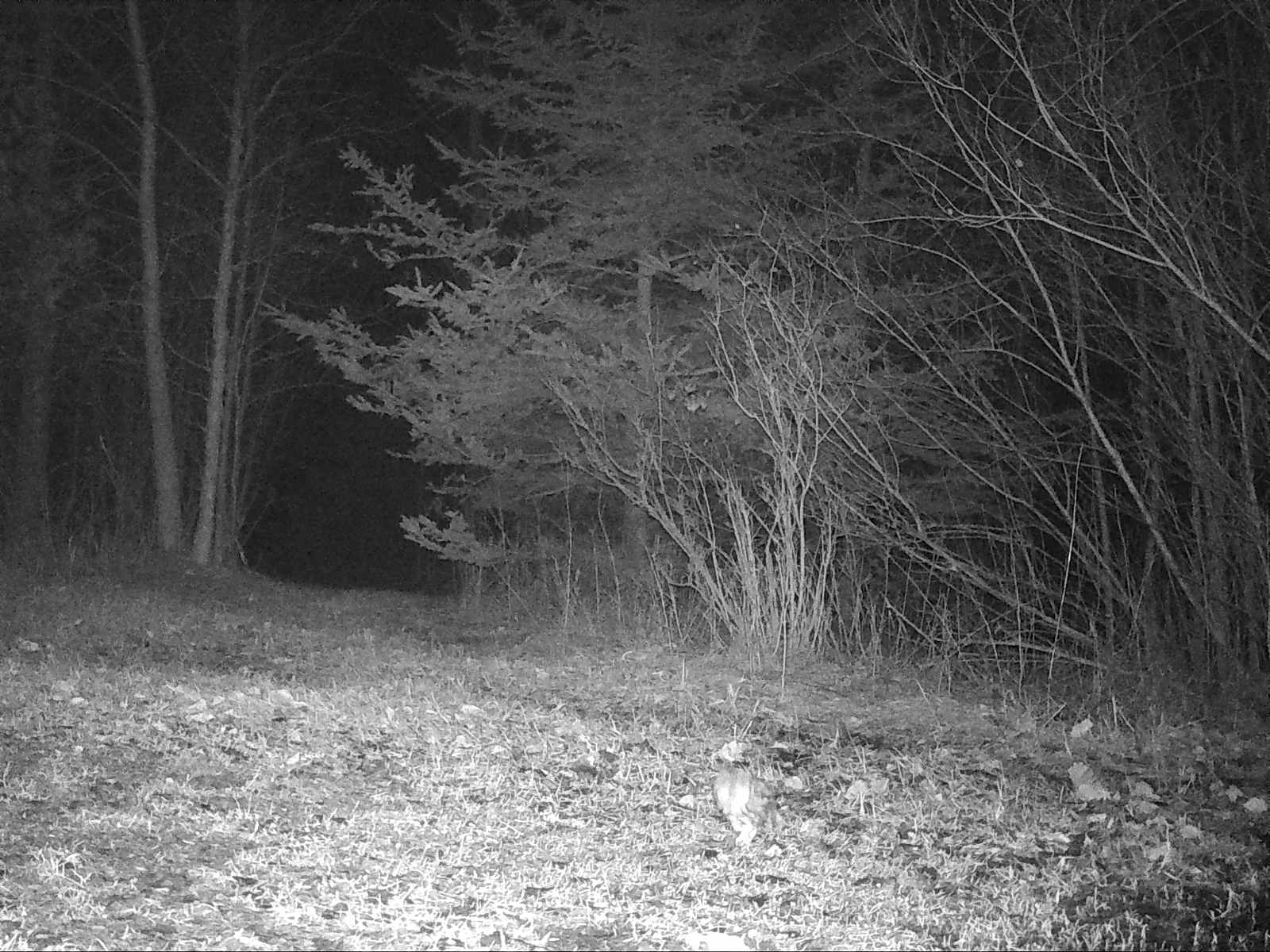
And a cottontail
Saturday, September 3, 2022
How To Tell A Crow From A Raven
The large all-black bird that you observe is likely a crow or a raven and they both happen to belong to the same family known as Corvidae and the genus Corvus. The latter actually being Latin for crow.
This species makes its home throughout the world with the exception of Antarctica and South America. While the common raven is more abundant on a global basis it is found in the western US, Appalachian Mountains, northern reaches of Wisconsin into Canada and Mexico. The American crow is found throughout the US and Canada.
Both birds are year-round residents here and the best way to tell them apart is by the difference in size. Ravens are larger.
There is also a subtle difference in their beaks - ravens sport a larger, curvier beak with larger bristles at the base. This aids the raven in the pursuit of its preferred meal of roadkill and carrion. In contrast crows are largely herbivores and will eat roadkill only rarely.
Vocalizations are different too. Crows caw and ravens croak. Ravens will also scream - a vocalization used to attract others to a particularly good source of food.
Listed as a species of least concern neither of these birds are endangered. As a matter of fact they respond positively to the presence of people and the easy food resources that accompany urbanization and fragmentation.
Even though these birds belong to the same genus they are indeed biologically different as described in the preceding paragraphs. While both are among the most intelligent animals on the planet, ravens excel at problem-solving, mimic the calls of other birds and possess the ability to plan in advance. Crows have the ability to recognize individual people.
They don't necessarily coexist and have been known to raid each others' nests and compete for territory and food resources. Strangely, the smaller crows make the most trouble.
If you want to learn more about the lives of these birds here at The Platz you can search under crow or raven using the labels on the homepage of the blog or plug either name or the word: corvus in the search feature in the tool bar above.
| Raven |
![]() |
| Crow |
Sunday, April 3, 2022
Roadkill
This is the final slug of trail camera photos taken over the road killed whitetail that I dragged to this location.
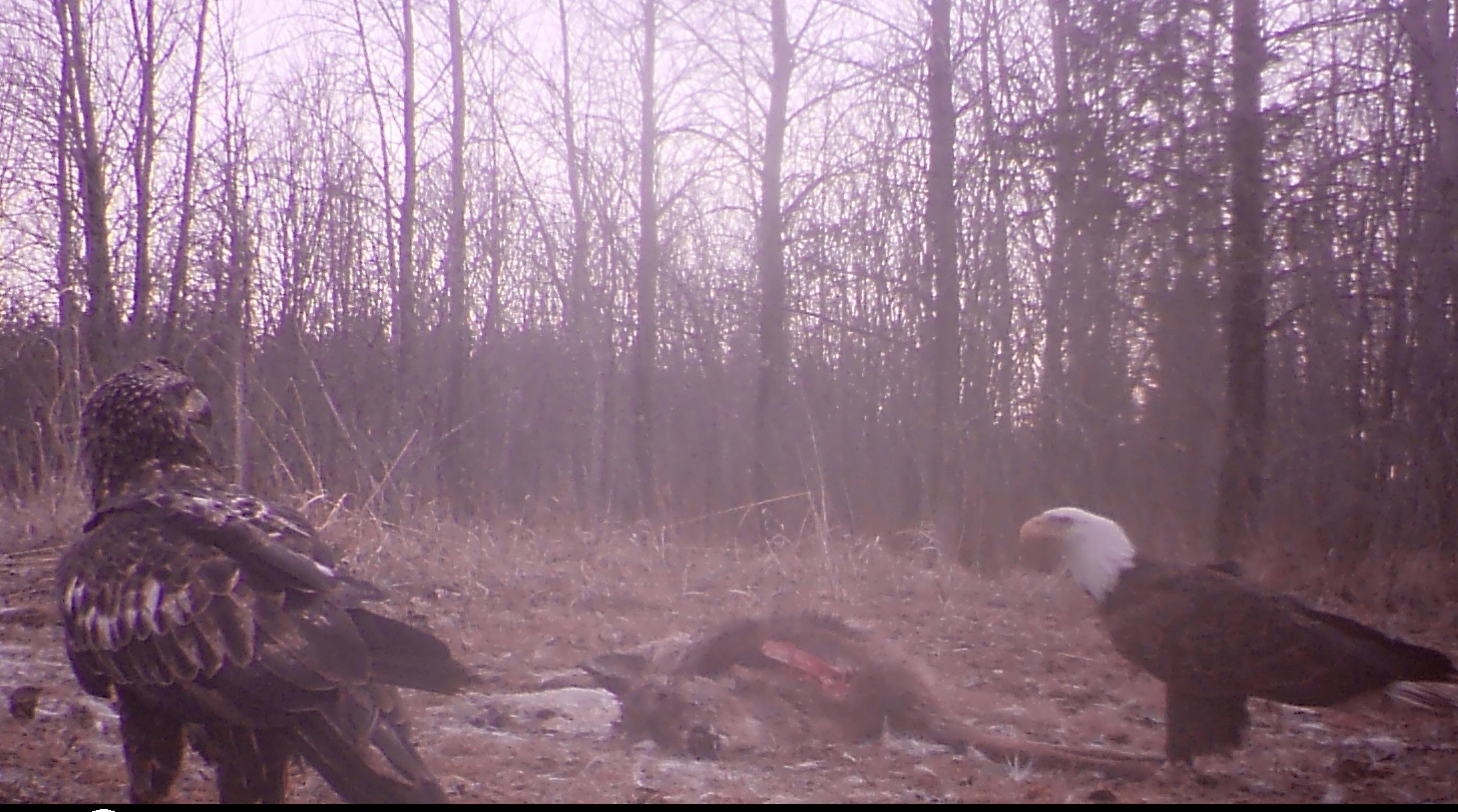
Here's a juvenile and adult bald eagle...
And a couple of adult bald eagles. It is thought that these birds mate for life; although they may switch it up with an alternate if unsuccessful at breeding. A couple of weeks ago Jill took a photo of a couple of adults (these?) along with a juvenile perched in a cottonwood tree on the bank of Silver Creek...
Another photo of a juvenile and adult. We've been witness to regular bald eagle sightings in the last few years. A big improvement over no sightings around here twenty years ago. My conclusion is there may be a nest located in the Brussels-Kolberg area or perhaps along the coast near-by...
Here's a juvenile coming-in for a landing. In the trail camera world an action photo such as this is can be called a Money Shot...
Adult...
Two juveniles sparring over the scraps...
Another Money Shot - a classic image of an adult eagle...
Wile E. Coyote and the resident raccoons most always come sneaking-around after dark...
Last photo to be shared. You can see that the resident scavengers picked the whitetail clean. Nothing but skin and bones remain. This is a great lesson demonstrating the circle of life.
I'm going to editorialize a wee bit. If you have a road killed deer in a ditch close to where you live please slow down give the critters a break. Just last week there was a local news item about an adult eagle that was struck and killed by a motorist as it was scavenging a road killed deer. The person who killed the bird never reported it. That sucks.
Wednesday, March 30, 2022
Roadkill
There nothing left of the road-killed whitetail now but skin and bones. Nevertheless, there are plenty of trail camera photos yet to share so be sure to stop-by from time to time and check them out.
This is a juvenile bald eagle. The large, distinctive hook beak is one of the characteristics to aid in identification of this bird in the field. Juveniles gain the characteristic bald eagle white head and tail at 4-5 years of age.
This is a rough-legged hawk. The raptor takes its name from the feathers that extend down the legs to the base of the toes - an adaptation to the cold environment this bird prefers. This hawk is only seen here on the peninsula during the winter months with the southern-most extent of its winter range being the Texas panhandle. Summer breeding range is the northernmost extent of Canada's coniferous forest zone and escarpment bordering the arctic tundra.
Wile E. Coyote. This canine has been tugging and dragging the deer carcass from here to there.
Adult bald eagle stretching her wings. At up to a 7-foot wingspan this is a Big Bird.
And there is this. A raven selfie. And I am really digging the hair do.....