Showing posts with label Lunar Eclipse. Show all posts

Sunday, March 1, 2026

March Astronomy - Blood Moon

The full moon for the month of March is frequently called the Full Worm Moon.  The backstory is because of the earthworms that wriggle out of the ground as the earth begins to thaw in March.  As a consequence some Native American Tribes referred to it as the Worm Moon and the return of robins to feast on the emerging worms.

The fact of the matter is that Northern tribes would not have embraced this name for the March moon as there were no earthworms. A Southern tribe maybe – but certainly not a Northern tribe.


Historically, earthworms did not exist in the northern reaches of continental North America. The ice sheets of the last glaciation wiped them out. All of the earthworms and night crawlers we see nowadays were introduced by European colonists – brought here in plant root balls and soil used as ship ballast. That’s right – earthworms are an invasive species.  But I digress.

Northern American tribes such as the Shawnee tribe know this as the Sap Moon - a reminder for the tribes that they can begin tapping maple trees for the making of syrup.

In general, March’s full moon is known as a herald for the beginning of spring and new agricultural cycles. The European settlers referred to this as the Lenten Moon and as a way to measure the progress of their crops. They called it the Storm Moon if the weather was inclement – an indicator their crops might fail. Under ideal growing conditions they called it the Rugged Moon – a sign of a successful harvest that year.

One of its other names is the Chaste Moon, symbolizing the purity of early spring. The Pueblo tribe named it the Moon When the Leaves Break Forth, The Cree called it the Goose Moon, while in Shoshone culture it was known as the Warming Moon. The Ojibwa called it the the Crows Come Back Moon, after the crows and other birds that appear as winter draws to a close.  It is also called the Crust Moon, because of the snow that becomes crusty when it thaws in the sun and freezes in the moonlight.

The moon will be at its fullest tomorrow evening although to the casual observer it will appear full this evening.

There's a bonus this year; a total lunar eclipse.  This full moon will pass directly through the Earth's umbral shadow producing a total lunar eclipse visible to about 2.5 billion people (a third of the world population) across North America, Australia, New Zealand East Asia and the Pacific.  At my latitude the action will unfold around 3:50 AM Tuesday morning with the first "bite" out of the moon beginning.  Totality will commence at 5:04 AM and at maximum eclipse, 5:33 AM, the moon will be fully in the earth's shadow and it will appear reddened - a Blood Moon.  Totality will end at 6:02 AM and, depending-upon your precise location, the moon will set around 6:26 - 6:33 AM.  

Viewing Tips:  Look toward the west/northwest and find a clear, unobstructed view of the western horizon as the moon will be very low in the sky at totality.  If you live in the city, Newport State Park is designated as a 'Dark Sky Park' and a prime viewing location.  If you live in flyover country like me you'll likely have near-optimal viewing conditions.  Lastly, this is a lunar eclipse and no special eye protection is needed.  If  you have a pair of binoculars or a telescope - use them.

Fingers-crossed for clear, early morning skies...


Edit to add:
 
My view west of the lunar eclipse Tuesday morning at 4:48 am.

Sigh....


Thursday, March 13, 2025

Blood Moon

March’s full moon is frequently called the Full Worm Moon.  The backstory is because of the earthworms that wriggle out of the ground as the earth begins to thaw in March.  As a consequence some Native American Tribes referred to it as the Worm Moon and the return of robins to feast on the emerging worms.

The fact of the matter is that Northern tribes would not have embraced this name for the March moon as there were no earthworms. A Southern tribe maybe – but certainly not a Northern tribe.


Historically, earthworms did not exist in the northern reaches of continental North America. The ice sheets of the last glaciation wiped them out. All of the earthworms and night crawlers we see nowadays were introduced by European colonists – brought here in plant root balls and soil used as ship ballast. That’s right – earthworms are an invasive species.  But I digress.

Northern American tribes such as the Shawnee tribe know this as the Sap Moon - a reminder for the tribes that they can begin tapping maple trees for the making of syrup.

In general, March’s full moon is known as a herald for the beginning of spring and new agricultural cycles. The European settlers referred to this as the Lenten Moon and as a way to measure the progress of their crops. They called it the Storm Moon if the weather was inclement – an indicator their crops might fail. Under ideal growing conditions they called it the Rugged Moon – a sign of a successful harvest that year.

One of its other names is the Chaste Moon, symbolizing the purity of early spring. The Pueblo tribe named it the Moon When the Leaves Break Forth, The Cree called it the Goose Moon, while in Shoshone culture it was known as the Warming Moon. The Ojibwa called it the the Crows Come Back Moon, after the crows and other birds that appear as winter draws to a close.  It is also called the Crust Moon, because of the snow that becomes crusty when it thaws in the sun and freezes in the moonlight.

The moon will be at its fullest tomorrow evening although to the casual observer it will appear full this evening.

There's a bonus this year; a total lunar eclipse.  This full moon will pass directly through the Earth's umbral shadow producing a total lunar eclipse visible across the Americas and a partial eclipse in the Pacific, Western Europe and Africa.  At my latitude the action will unfold around 10:30 tonight with the first "bite" out of the moon beginning around midnight.  At maximum eclipse, 2 AM, it will appear reddened - a Blood Moon.


Monday, November 7, 2022

November Night Sky

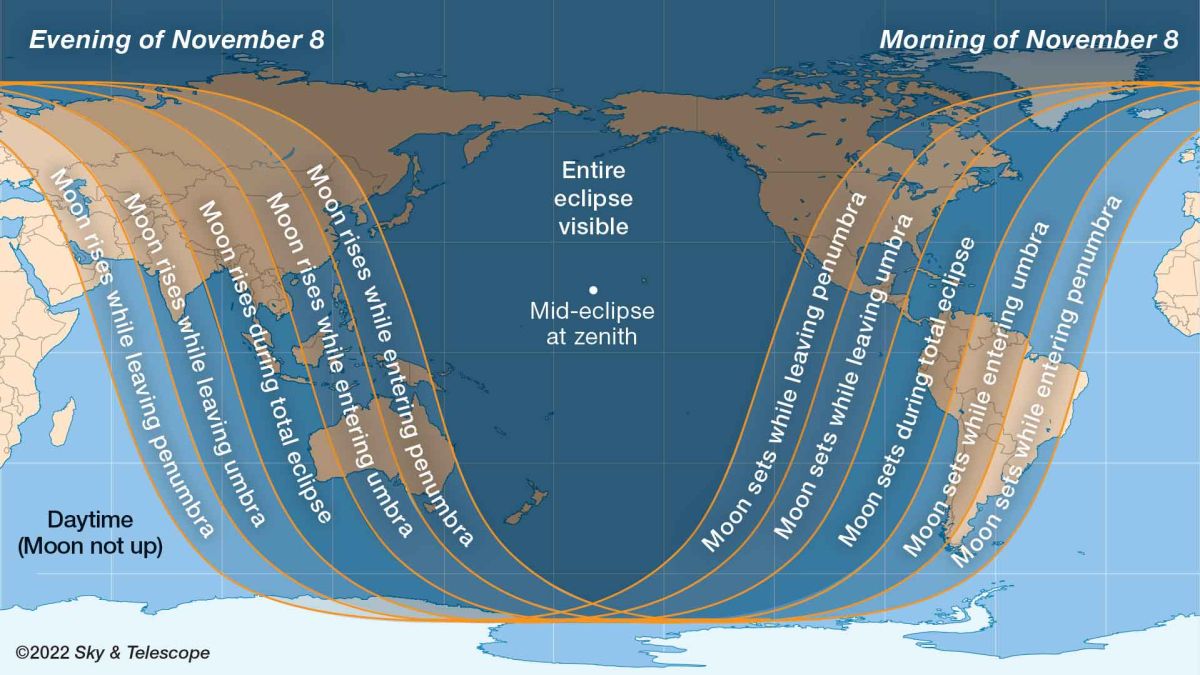
This month’s full Moon, also called the Beaver Moon, includes a total lunar eclipse.

BONUS!

NASA Image

Starting at about 3 AM on the east coast the Earth’s shadow will begin to slowly creep across the Moon’s surface, reaching peak eclipse around 5 AM here in Wisconsin.  At this point, the Moon will take on an eerie reddish color, with 100% of its surface fully eclipsed by Earth’s shadow.

During a lunar eclipse the moon can take on a a red hue that is a consequence of the light from the sun hitting its disk after being bent around the earth by our planet's atmosphere which filters out blue light from the color spectrum.

This is the second and final lunar eclipse of 2022 with the previous eclipse occurring on May 16.  The next lunar eclipse, and the first of 2023, will occur on May 6.  This only a partial eclipse which will make it easier to miss.

Full moons often take their names from the traditions of native Americans and European
settlers.  November is the time of year that beavers retire to their lodges for the duration of
winter.  As a consequence of their pelts being prime this was also the time of year that fur
traders trapped beavers.

The Lakota people recognized this as the Deer Rutting Moon, Cree and Assiniboine called this the Frost Moon and with the spawning of this fish species in November the Algonquin called this the Whitefish Moon.

Fingers-crossed for cold, clear skies.


Saturday, May 14, 2022

Super Bloody Flower Moon

According to the Old Farmers Almanac - we adopt full moon names that were used during Native American and Colonial times to help track the seasons.  This practice is traced to the Algonquin tribes who lived in the same areas as the Colonists.    

May’s full Moon is known as the Flower Moon.  It signifies the wildflowers that bloom in May.  This includes wild iris, sundrops, marsh marigold, violets and more that are found around here.   The month of May marks a period of increased fertility and the warming days that made it safer to bear young.   For that reason it is sometimes called the Mother’s Moon.  Other names include the Corn Planting Moon and Milk Moon.  

The moon will appear full tonight but will reach its peak of fullness at 11:14 PM on Sunday.   

May's full moon also includes a couple of bonus features - namely it is a Supermoon and is witness to a Lunar Eclipse.

The moon's transit around the earth is not a perfect circle.  It is elliptical.  When a orbit of a full moon coincides with a closer pass near earth the moon will appear larger than it ordinarily would.  Hence it is referred-to as a Supermoon.

photo - NASA

Tomorrow, beginning around 8:32 CST, the moon will be entering earth's shadow or penumbra.  In short order the surface of the moon will begin to darken as it enters earth's full shadow or umbra.  

The full eclipse will begin around 10:30 PM and peak at 11:11 PM.  It will conclude around midnight.   

During the period of totality the moon will assume a ruddy, rusty color as a consequence of the earth blocking direct sunlight from reaching the moon's surface.  This phenomenon is called a Blood Moon.

Fingers-crossed for clear night skies to witness a special full moon experience this month.