I haven't spied a monarch butterfly in awhile.
From our walk there were bumblebees and viceroy butterflies in abundance.


I haven't spied a monarch butterfly in awhile.
From our walk there were bumblebees and viceroy butterflies in abundance.

Prairie Dock - Silphium terebinthinaceum. Also commonly called rosin weed. It is a sunflower-like plant it can grow to a height of 9 feet. With a 14 foot tap root it is exceedingly drought-resistant and can flourish for decades.
The plant gets the name rosin weed because it produces a sweet-smelling resin when injured. While Prairie Rosin weed is the correct name for this specific plant, there are other plants called rosin weed that are different species within the same genus, Silphium.
It is just now beginning to come on-line and pollinators are
attracted to it as it blooms for more than a month. Birds love the seeds.
When
we planted our prairie 20 years ago this species was not in the seed
mix. Like several other species it has found its way here and
established itself on its own.
Bonus!
Papilio cresphontes - commonly known as the giant swallowtail; the largest butterfly species in North America!
This really made our day as this was a first for us. And first experiences are, as a general rule, the best of the best. The Missus captured this video:
You'll find this critter throughout the eastern and southern United States, Mexico, Central America, and into South America. In the US it’s most common year-round in the Southeast, but its range extends into the Midwest and as far north as southern Canada during warmer years.
Larva caterpillars are called orange dogs and feed on orange, lemon, lime and grapefruit leaves. They have a unique defense in that they resemble bird droppings and emit a foul odor to deter predators.
Adults have a strong gliding flight and favor flowers featuring nectar. Around here they're generally welcome as pollinators; although if you're a citrus grower in Florida or Texas you may feel differently.
Meet Vernonia noveboracensis - commonly known as Ironweed. It caught my eye while out bushwhacking trails and wildlife openings the other day. It seemed a bit too early for New England Asters so I thought I better check it out.

It is indeed a striking purple color and hard to miss. It is a perennial native east of the Mississippi ranging from Massachusetts to Florida. It belongs to the Asteraceae (sunflower) family and this specimen was north of four feet tall. We didn't plant it but we're tickled to welcome it as butterflies and bees love it.
They're commonly found in open woodlands, meadows, fields, and along roadsides across much of North America, including Wisconsin. Adults feed primarily on nectar from various wildflowers, including milkweeds, thistles, and ironweed. Their caterpillars feed on violet leaves - commonly found growing throughout the farm but primarily in the floodplain of Silver Creek.


The Frau took this photo the other day.
She shared it with me.
And I'm sharing it with you.

From our morning walk the other day there were these showy, native flowers.

Bee Balm

Black-Eyed Susan

Blue Vervain

Compass Plant

Gray-Headed Coneflower

Joe Pye Weed

Obedient Plant

Prairie Blazing Star

Purple Coneflower

Purple Prairie Clover

Spring has been cooler and late this year; consequently this forb is
about 2 to 3 weeks delayed. From our walk this morning there was
Penstemon digitalis - commonly known as Smooth Penstemon.
A member of the snapdragon family this showy native to the prairie is
also called foxglove or beardtongue. Native Americans and folk-healers
have made use of this plant for medicinal purposes for both people and
animals.
On our pollinator habitat this is the first species to materialize in
large quantities. And there is an abundance of this blooming beauty.
Acres upon acres of the stuff. This flower appears during late spring
or early summer for about a month and then it’s gone.

The doggo and I got a pretty good gig going for us. Step outta the house and there’s
approximately 3.5 miles of trails to walk. Better yet, the pup doesn’t
have to wear a lead and I don’t get dragged along behind one. All she
wears is her hunting e-collar just in case. Our walks are free range and à la carte.
North of a year and a half-old Ruby has certainly matured. Of course
that’s relative as she’s still stuck somewhere between puppyhood and
solid adulthood. Nevertheless, she follows voice commands and generally
sticks close. If I stop to examine something I’m curious about she’ll
wait for me to catch-up. Conversely, if she’s after something of
interest, her bell is a good cue as to her whereabouts. And she returns
when summoned.
The other day we checked-out the prairie habitat north of the house. This stuff
is absolutely not indigenous peninsula habitat; but it’s good wildlife
cover and it’s our property so we plant what we like.
This is excellent pollinator habitat three seasons of the year so it
attracts a lot of birds. In the fourth season of winter it is terrific
cover for overwintering birds and other critters.
Those grasses and forbs that have been blown-down in the photo were
about six feet tall at their prime. Tumbled-over they form thousands of
hollow cavities and caves at ground level. When covered by snow these
become snug animal igloos.
Sure enough - thermal cover for the birds and other critters to hunker down and hide from the wind and snow. Predators too.
Now play Where’s Waldo and find the dog in the photo…

From our walk yesterday we note changes occurring daily in the pollinator habitat.
There are a few Black-eyed Susans emerging among acres of Penstemon.
Talked the dog into posing with some False Sunflower (Ox-Eye).

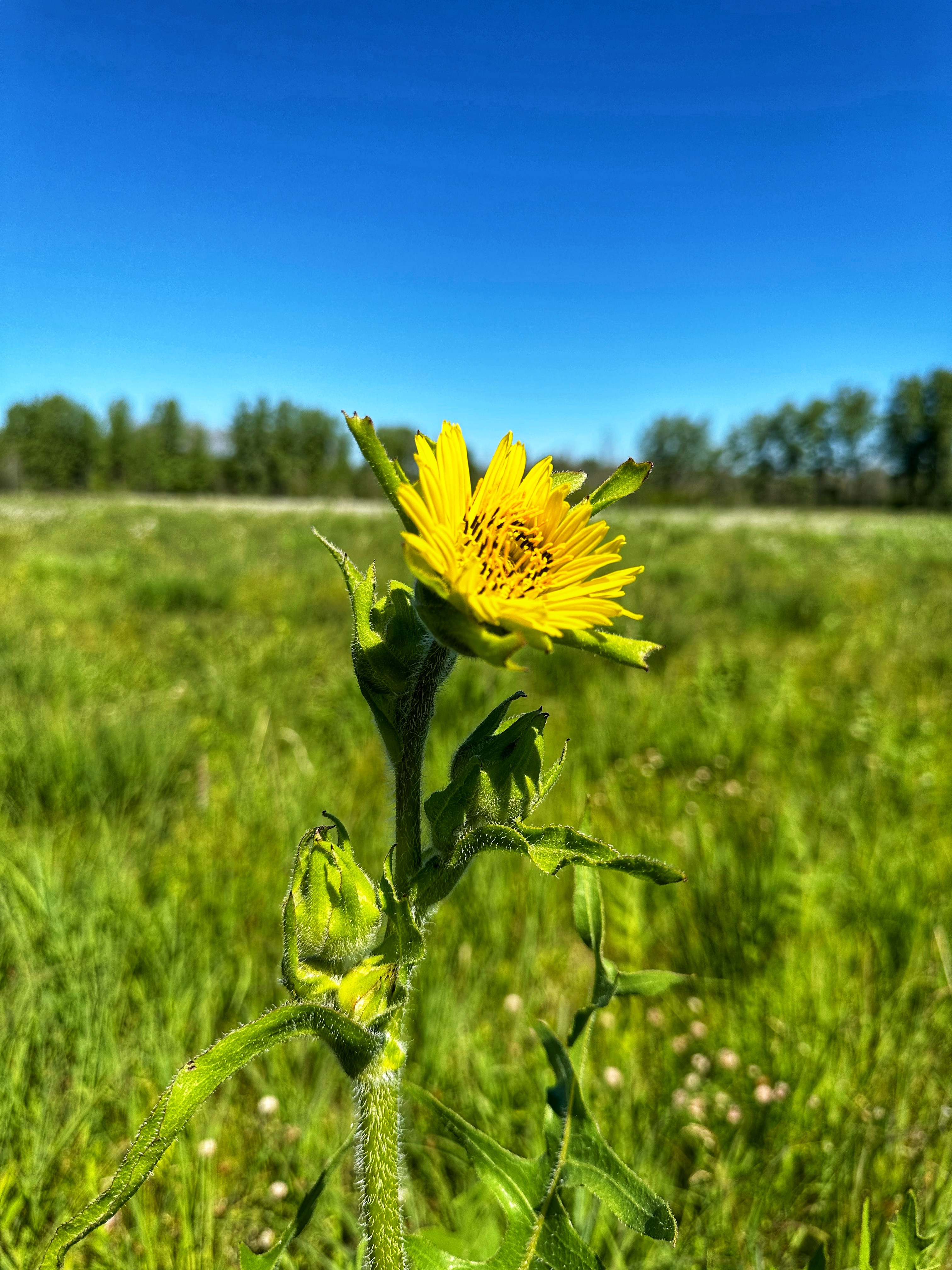

Meet - Penstemon digitalis - commonly known as Smooth Penstemon.

While on my daily walk with the dog I've begun to notice some of the trees are beginning to turn on their fall foliage. Nevertheless, the fall colors are not restricted to tree leaves. The fall flowers are really pulling-out the stops with a color palette that is attracting the bumble bees, honey bees and other pollinators on the landscape.
From one of our recent walks there was this...


 |


Heliopsis helianthoides. Commonly called Ox-eye this native plant is a member of the aster family.
A great butterfly attractant it is also another showy wildflower.


It remains rather brown outside and when it is dreary and rainy it's difficult to imagine spring. That is, unless, you get out of doors and examine the natural world that surrounds you.
From our walk yesterday there was this.

This is the petal-less flower associated with willow, birch, hickory and a few additional trees.
Willows thrive in the wetter soils found around here and form tangled thickets that provide valuable wildlife habitat. The flowers you see pictured emerge in early spring before the leaves. Willows are dioecious with male flowers are associated with a separate plant from those that bear female flowers.
This is a common native tree found throughout Wisconsin. Depending upon the season it is also commonly utilized in floral arrangements.
Since this is one of the very first spring blooms they are a sure sign of the end of winter and the beginning of spring.
*Memo to self - be sure to keep a lookout for the first honey bees of 2021




 Posts
All Comments
Posts
All Comments


