Showing posts with label Non Native Wildflower. Show all posts

Tuesday, July 9, 2024

The Healer

From our walk the other day there is this.

Prunella vulgaris - commonly known as Heal-All. A non-native member of the mint family this plant routinely makes its home in and along the edges of our trails. 

As an herb it plays a role in folk-medicine and alternative healing.  If the internet is to be believed a weak infusion of the plant can be used as a medicinal eye wash for sties and pinkeye.  If you ingest a tea made from the plant it can treat fevers, diarrhea, sore mouth and throat, internal bleeding, and weaknesses of the liver and heart.  

There is questionable clinical evidence of antibacterial properties that inhibit the growth of pseudomonas, Bacillus typhi, E. coli, and Mycobacterium tuberculi supporting its use as an alternative medicine internally and externally as an antibiotic and for hard to heal wounds and diseases.  

Some suggest it can also cure herpes, cancer, AIDS, diabetes, and many other maladies.  Apparently I have a regular pharmacopeia of cure growing with abandon in my trails.

For kicks I crushed a bit between my hands and it did smell remotely like skunky mint.  But I'm not eating any of it.

Saturday, July 8, 2023

False Indigo

Meet Baptisia australis - Blue False Indigo.


A member of the pea family it is characterized by large clover-like leaves (up to 3 inch); leaflets wider toward the tips.

Flowers are large (1 inch), dark blue or violet, in erect racemes.  Grows to three to five feet tall.

Native to southern Indiana, west Virginia, Pennsylvania south.

This is growing in our yard so it has obviously been introduced.

Can locate the bumble bee?

Tuesday, August 2, 2022

Wild Flower Walk


Meet
Chrysanthemum leucanhemum.  Also called the Common Daisy or The Ox-eye Daisy.

Technically a non-native, it is a European immigrant.

In keeping with the folk-healing pharmacopeia of plant life around here it contains pyrethrin - a chemical that repels insects and s used in organic pesticides.

It is a nice garden plant that you'll find growing all over the Platz.

We use a spray of these to decorate the dinner table or the cocktail tables on the porch.

Sunday, July 31, 2022

Wild Flower Walk

Plants and flowers have long held an important role in both folk and modern medicine.  Smooth penstemon (Penstemon digitalis) has been used to treat fever and the chills.  And if you chewed the root you might find relief from a toothache.

Meet Prunella vulgaris - a plant called Heal-All. A non-native member of the mint family this plant routinely makes its home in and along the edges of the trails at The Platz. 

As an herb it plays a role in folk-medicine and alternative healing.  If the internet is to be believed a weak infusion of the plant can be used as a medicinal eye wash for sties and pinkeye.  If you ingest a tea made from the plant it can treat fevers, diarrhea, sore mouth and throat, internal bleeding, and weaknesses of the liver and heart.  There is purported (questionable) clinical evidence of antibacterial properties that inhibit the growth of pseudomonas, Bacillus typhi, E. coli, and Mycobacterium tuberculi supporting ts use as an alternative medicine internally and externally as an antibiotic and for hard to heal wounds and diseases.  Some suggest it can also cure herpes, cancer, AIDS, diabetes, and many other maladies.  Apparently I have a regular pharmacopeia of cures growing around here. 

For kicks I crushed a bit between my gloved hands and it did smell remotely like skunky mint.  But I'm not eating any of it.

Tuesday, July 19, 2022

Wildflower Walk

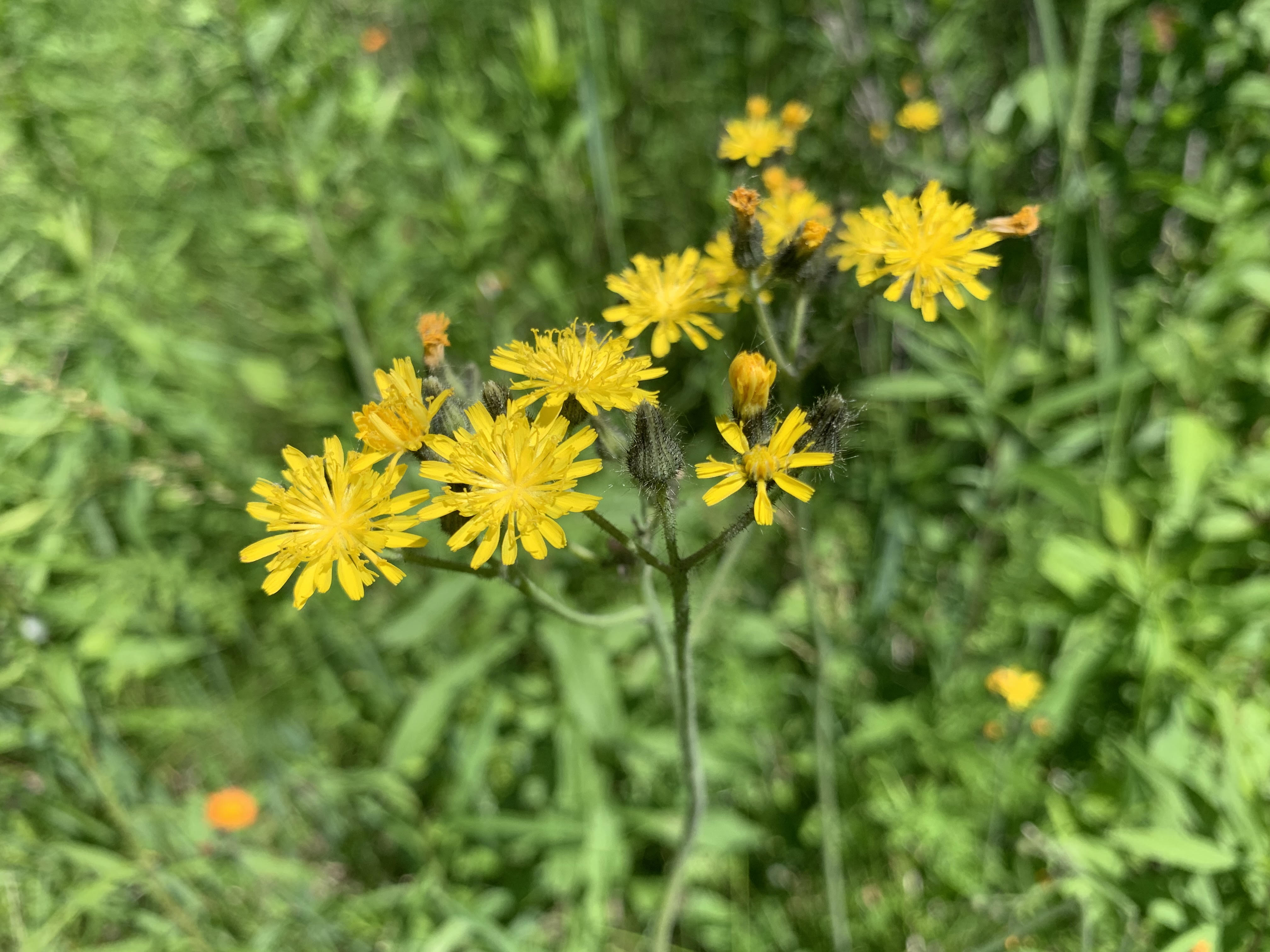
  Meet Hieracium aurantiacum - Orange Hawkweed.   

Technically a non-native this happens to be an import from Eurasia and is an alpine plant.  It grows throughout Wisconsin in pastures, disturbed fields and along roadside ditches.  Like its yellow Canada cousin this member of the aster family takes its name from the folklore that hawks ate this plant to improve their eyesight.      

It is also called the Devil's Paintbrush as its single stem is topped with a red orange color resembling a paint brush.      

It's now naturalized all over North American and all over here.


Wednesday, July 6, 2022

Wildflower Walk


Meet Hieracium kalmia – Canada Hawkweed.  One of seven species of hawkweed that grows in Wisconsin. Technically a non-native this species has a cool feature.  The flowers close at night and on cloudy days.

The common name - Hawkweed - came from the folklore belief that hawks ate the flowers to improve their vision.       

Like related members of the aster family this variety is now naturalized all over North American and all over here.

Thursday, June 25, 2020

Orange Bloom


Meet Hieracium aurantiacum - Orange Hawkweed.        


Technically a non-native this happens to be an import from Eurasia and is an alpine plant.  It grows throughout Wisconsin in pastures, disturbed fields and along roadside ditches         

It is also called the Devil's Paintbrush as its single stem is topped with a red orange color resembling a paint brush.      

It's now naturalized all over North American and all over here.

Wednesday, June 24, 2020

Yellow Bloom


Meet Hieracium kalmia – Canada Hawkweed.  One of seven species of hawkweed that grows in Wisconsin.          


Technically a non-native this species has a cool feature.  The flowers close at night and on cloudy days.


The common name - Hawkweed - came from the mistaken belief that hawks ate the flowers to improve their vision.       

Like related members of the aster family this variety is now naturalized all over North American and all over here.

Wednesday, July 3, 2019

Non-Native Blooms

Meet Hieracium aurantiacum - Orange Hawkweed. 

click on images for a closer look
 
And Hieracium kalmia – Canada Hawkweed. 


Both of these showy flowering plants belong to the aster family.  They’re not native plants yet they may be found throughout Wisconsin in pastures, disturbed fields and along roadside ditches. 


The yellow variety has flowers that close at night and on cloudy days.  The orange variety is native to Eurasia and is an alpine plant.  It is also called the Devil's Paintbrush as its single stem is topped with a red orange color resembling a paint brush. 


The common name - Hawkweed - came from folklore that hawks ate the flowers to improve their vision.   These plants are now naturalized all over much of North American and all around here – and they should continue to put on a flowering show for the duration of summer.

Saturday, June 8, 2019

Even More Early Blooms

From one of our daily walks we found this......  
 
click on image to enlarge
 
A member of the mustard family of plants this is Barbarea vulgaris - commonly known as Winter Cress. 

This is one of the earliest plants to bloom in the spring.  As its name implies - you can find it poking thru the snow remaining on the ground.  There's no snow anymore around these parts and this is blooming-up a storm in the dappled sunlit locations near the banks of Silver Creek. It happens to be a non-native biennial plant and because it emerges early in the growing season is an early and welcome source of fodder for the local deer herd.

If you fashion yourself a healer and are into folk medicine this plant has been used by early settlers as a poultice to treat wounds from farm and hunting accidents.

The tiny black seeds of this flower are exceedingly hot and also make a natural pepper substitute.

Saturday, July 8, 2017

Heal-All

click image to enlarge

Yesterday I introduced you to the common milkweed and some of it's curious effects caused by compounds known as cardiac glycosides.  In keeping with the medicinal theme I wish to introduce you to Prunella vulgaris - a plant called Heal-All. A non-native member of the mint family this plant routinely makes its home in and along the edges of the trails at The Platz. 

As an herb it plays a role in folk-medicine and alternative healing.  If the internet is to be believed a weak infusion of the plant can be used as a medicinal eye wash for sties and pinkeye.  If you ingest a tea made from the plant it can treat fevers, diarrhea, sore mouth and throat, internal bleeding, and weaknesses of the liver and heart.  There is purported (questionable) clinical evidence of antibacterial properties that inhibit the growth of pseudomonas, Bacillus typhi, E. coli, and Mycobacterium tuberculi supporting ts use as an alternative medicine internally and externally as an antibiotic and for hard to heal wounds and diseases.  Some suggest it can also cure herpes, cancer, AIDS, diabetes, and many other maladies.  Apparently I have a regular pharmacopeia of cure growing with abandon in my trails.

For kicks I crushed a bit between my gloved hands and it did smell remotely like skunky mint.  But I'm not eating any of it.

Sunday, July 3, 2016

Black-Eyed Susan


Rudbeckia hirta - Black-eyed Susan - a member of the aster family.  Sometimes called the Brown-eyed Susan it is a native perennial that is now found just about everywhere from fields to yard gardens.  

Finches value the seeds they produce but I value their blooming this time of year.  With the official arrival of summer these plentiful yellow flowers are adding more color and variety to the prairie planting.  

Furthermore, my brown-eyed, four-legged girls also like to stop and take moment to smell the flowers.


 click on images to enlarge

Saturday, May 28, 2016

Deer Food

click image to enlarge

Meet Barbera Vulgaris - Winter Cress. A biennial non-native.  Between you and me I think that is a really cool name.

I found this growing in the tall grass field out back of the house. It belongs to the mustard family even though it it is not a true mustard.  One of the first wild flowers to bloom in the spring and as a member of the brassica family it is a favorite of whitetail deer.

If you want to practice some folk medicine you can use the plant to make a poultice to treat wounds and its tiny black seeds as a pepper substitute.

It grows just about everywhere and you'll fine it throughout Wisconsin.  There doesn't seem to be a large amount of this non-native growing around here so I'm hopeful the over-abundant deer around here will eat it all and save me the effort of applying an herbicide.