Saturday, June 21, 2025

Original Sack Lunch

The Deerfield (Michigan) Testicle Festival is a fundraiser for American Legion Post 392 that’s been held every March for over two decades, started by some folks with a great sense of humor. 

They buy hundreds of pounds of Rocky Mountain Oysters—deep-fried bull testicles—every year, a few volunteers cook them up a day or two before the event, and they serve them on a first-come-first-serve basis. 

Learn more about this road trip destination here. 

Friday, June 20, 2025

Midsummer

Shot an azimuth a few moments ago.

Happy solstice everyone…..


What To See In The June Sky

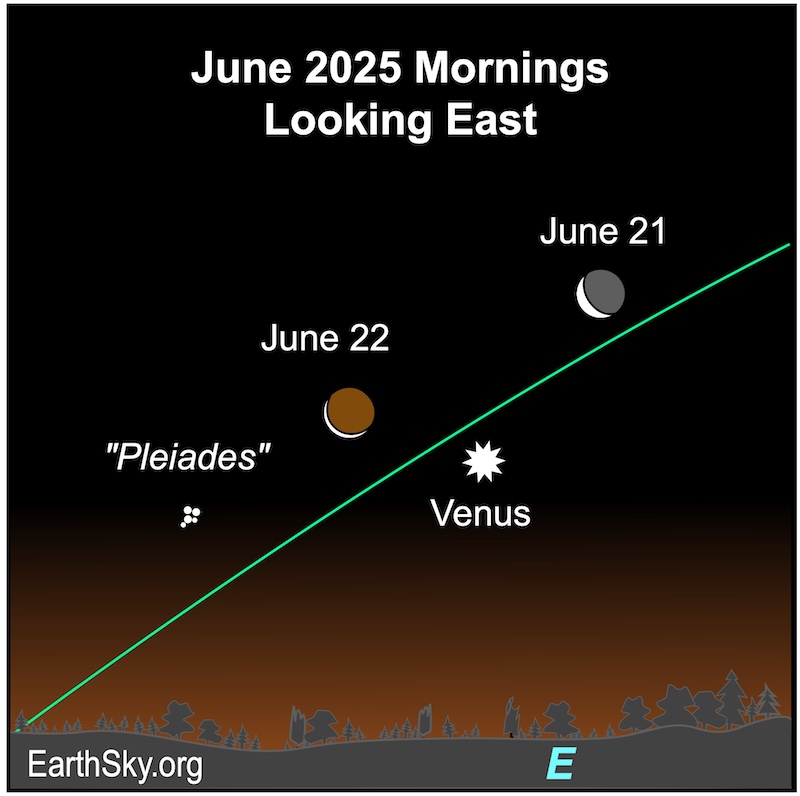
If you have to get-up from your slumber to pee anytime before sunrise tomorrow or Sunday morning cast your gaze to the eastern horizon.

You should be able to spot with the naked eye the thin waning crescent moon along with a very bright Venus and the Pleiades star cluster.

If you look carefully you might be able to spot the glow of earthshine on the unlit portion of the moon.  Earthshine is light reflected off the earth.

Of course, a pair of binoculars make it easier..... 


Friday Music

This famous bluegrass instrumental written by Earl Scruggs in 1949 and was recorded by Scruggs and the Foggy Mountain Boys.  It's known for its fast-paced banjo picking and is widely considered a classic of American roots music.  I posted on this song earlier in February and somehow it popped-up in my YouTube channel feed.  So it's back 

This song helped define the sound of modern bluegrass. Its technical banjo style inspired countless musicians and is often used in banjo competitions and bluegrass jams.

Culturally it was featured prominently in the 1967 film Bonnie and Clyde, which reignited interest in bluegrass music.

Foggy Mountain Breakdown.....

Thursday, June 19, 2025

Beautiful Skies

Gentle spring storms moved thru late afternoon treating us to a colorful sky display.

View to the southeast...


And directly behind me the view to the northwest...


Ma Nature knocked one outta the part tonight. 
 

Serving Suggestion

Molly Bee was an American country music singer and guitarist famous for her 1952 recording of the early perennial "I Saw Mommy Kissing Santa Claus" and as Pinky Lee's sidekick on The Pinky Lee Show. 

Here she is pitching frozen hamburgers.

I ate my share of these growing-up in the 1960s and can vouch for the excess fat and shrinkage of these frozen hockey pucks.

Further evidence of the menu wasteland of my childhood; and prescient of the culinary renaissance that would emerge forty years later....

What To See In The June Sky

There is an old saying about making hay while the sun shines - a recognition that farm chores last as long as there is daylight.  The last four weeks have been witness to my neighbors fetching their first cutting of hay; along with spreading manure, tilling, discing and planting.  It has been a busy place here in flyover country. 

We know that the summer solstice tomorrow marks the longest day of the year yet the latest sunset of 2025 doesn't occur on that date.  Let me explain.

Solstice Stone - Stonehenge, UK

The solstice marks the farthest point of advance in the sun's relentless march to the north, delivering the maximum daylight hours of the year for the Northern Hemisphere and the minimum daylight hours of the year for the Southern Hemisphere.  The solstice this month marks the beginning of summer here in the Northern Hemisphere and the winter in the Southern Hemisphere.  

The word solstice literally translates to: sun standing still.  Following this event the sun begins to march in the opposite direction and heads south with our daylight hours getting shorter.  Daylight will continue to dwindle until December 21 - The dark days of the winter solstice - and the first astronomical day of winter after which the process reverses and repeats itself.    

All of this aside, there is a curious paradox in play as a few evenings immediately following the solstice seemingly and inexplicably get brighter.  

If you were to check your Farmers' Almanac sunset tables on pages 150 and 151 you would note that at latitude 40 degrees north the sunset occurs at 8:33 every day from June 21st thru July 3rd.  On June 27th it will set a few seconds later compared to the 26th or 28th.  

What gives?

We all know that following the solstice the days grow shorter so logically the sun should be setting earlier, no?

Here in the northern hemisphere, where you live halfway between the equator and the north pole, on the 27th of June the sun will set just a few seconds later.  While this would seem to defy both logic and the science about days getting shorter; as a consequence of our elliptical orbit around the sun and the phenomenon astronomers call analemma the earth is several million miles farther from the sun and moving at the slowest speed around it. Which would explain the hiccup in the sun setting.

Most of you may not be making hay today; nevertheless, on Friday of next week enjoy a couple of extra seconds of sunlight as you take-in another sunset.

Cheers!