Showing posts sorted by relevance for query federal deficit. Sort by date Show all posts

Sunday, January 29, 2023

Sunday Morning Economics - Debt Ceiling Simplified

It is factual to say the our burgeoning federal debt is a consequence of budget choices made by both Democrats and Republicans.  It has been a bipartisan endeavor to borrow money to finance expanded federal spending, underwrite the indirect costs of tax cuts, maintain social safety nets and expand assistance during recessions.  It is an oversimplification to suggest that growth in spending is the sole domain of Democrats or cutting taxes is the sole domain of Republicans.  

Democrats and Republicans mutually engage in both pursuits.  

Recent history suggests that the largest drivers of our accumulation of debt has been the federal response to the economic downturns of the 2008 financial crisis and the 2020 pandemic crisis.

You may recall that when Obama took office in 2009 he inherited a recession from Bush.  In response, he persuaded Congress to authorize $787 billion in stimulus spending and tax cuts.  Safety-net spending continued at higher levels over the ext few years as the economy slowly rebounded.

After COVID spread across the globe in 2020 leaving floundering economies everywhere in its wake Trump persuaded Congress to authorize a much larger aid package exceeding $3 trillion.

Biden ascended to office in 2021 and signed into law an additional $1.9 trillion in stimulus.

It would be fair to question the efficacy of individual components of all of the foregoing.  Both parties continue their finger-pointing.  And economists disagree amongst themselves.  Nevertheless, there is general agreement that in the face of a serious economic decline federal spending (and its resultant borrowing) to protect citizens, businesses and stimulate the economy is a good thing.

There is also general agreement - amongst economists anyway - that recent inflationary pressures can be laid at the feet of flooding the economy with all of that liquidity.  But I digress.

So, is it a small matter to assign blame to individual parties or administrations for the debt?  Of course not.  Like I said at the outset this is bipartisan.  The deficit increased by roughly $12.7 trillion under the administrations of Bush and Trump.  And an additional $13 trillion under the administrations of Obama and Biden (so-far).

Of course, these are simply the raw numbers and do not account for the deficit impacts of policy decisions that persist for many years after presidents depart.  Nor does it address the fundamental principle of matching spending with revenue.  In years of extraordinary spending demands my own household may exceed its revenue resources.  But subsidizing a lifestyle solely with borrowing is reckless and fraught financial planning. 

The important thing to remember is that we got here largely as a consequence of the actions of the four most recent administrations.  As you witness the current drama remain mindful that any newfound spine for deficit spending is coming from many of the same members of Congress who sat idly by and with nary a whimper raised the debt limit three times while the former guy was in office. 

Sure, they want to blame everything on the current guy.  That is theatrics and politics.  I get it.

I'll conclude this post with an observation and admonition.  Failing to raise the debt limit does nothing to control spending for the simple reason that the money has already been spent.  Getting your undies in a knot for all the stuff they've already bought doesn't do anything to stop Congress from spending the money from the get-go.  It may keep your base in a near-state of constant agitation and near-erotic arousal but when you pick it apart it's conflated virtue-signaling.  Sure, I admit to being raised in a simpler time; but I learned this:

Paying your bills is virtuous.

Playing with dynamite is dangerous.

You're welcome.

And stay-tuned.....

Wednesday, February 25, 2026

How To Blow-up The Budget

From the WSJ there is this.

According to projections from the Congressional Budget Office (CBO) U.S. debt will rise to more than 100% of U.S. gross Domestic product (GDP) before the end of this year. 

Debt held by the public will balloon to more than $56 trillion by 2036 as annual deficits continue to mount, according to the latest projections from the Congressional Budget Office.  By later this year, the federal debt held by the public is expected to surpass the size of the entire U.S. economy.

The main drivers:  increased spending on entitlement programs as the nation's population ages as well as rising costs related to paying interest on the debt itself.  Republicans have taken issue with the projections, suggesting the CBO's assumptions on economic growth are too low.

Here's a closer look at the numbers, in five easy charts.

The CBO projects that the annual U.S. budget deficit will top $3 trillion by fiscal year 2036. The deficit was briefly that high when the federal government spent heavily during the Covid-19 pandemic. 

By fiscal year 2036, the deficit will hit 6.7% of GDP, up from 5.8% in 2025.

Social Security and Medicare costs will drive mandatory spending to 15% of GDP by fiscal year 2036. Mounting debt will increase spending on net interest to nearly 5% of GDP.

CBO projects a $23 trillion deficit from 2026 to 2035, up around $1.4 trillion from its last projection. Tariff revenue will only partly offset effects of the GOP’s ‘one big, beautiful’ tax law.*

Debt held by the public will surpass 100% of GDP this year and is projected to exceed 120% by fiscal year 2036.


*Projected revenues generated by import taxes are uncertain as a consequence of the recent SCOTUS decision.


Tuesday, August 20, 2024

Hot Tip

A couple of months ago I was chilling-out at the airport in Chicago waiting for a connecting flight.  At a kiosk to purchase an $8 bottle of water the credit card terminal said ADD GRATUITY.  What the hell?  Tipping an attendant watching me process my own transaction?  An interaction that lasted less than 15 seconds?  I even had to fetch my own water.  The attendant's sole purpose was to scan the bar code.  Some days I think that this business of tipping has gotten out of hand.  

It's madness and it makes me grumpy.

Yet the madness has spread.  Both contenders for the White House have gone on record as supporting an exemption of tipped income from the federal income tax.  Donald Trump had this to say: It's a large group of people that are being hurt badly.  They make money - let them keep their money.

It's not an original idea and it enjoys a reasonably high level of populist support.  Because, (surprise, surprise) nobody likes to pay income taxes.  Nevertheless it is bad policy.  Allow me to explain.

Between 1972 and 1978 I worked in the restaurant business as a waiter and bartender.  As a consequence I know how tipped income works.  I made a pretty good living with this arrangement considering it was a part-time gig.  And just like today tips were taxable income fifty years ago.

In an election year this concept plays well with workers in the hospitality industry.  It is Silly Season after-all and Nevada also happens to be a swing state so I get the need for pandering.  Nevertheless, carving-out one form of income for preferential treatment while ignoring all other sources of income runs afoul of all manner of unintended consequences.

Most obvious is how are you going to pay for it?  The nonpartisan Committee for a Responsible Federal Budget (CRFB) estimated that the Harris plan would increase deficits by $100 to $200 billion over a decade.  The Trump plan to exempt all tips from federal income AND payroll (FICA) taxes would reduce revenue by $150 billion to $250 billion.  So, how do you replace the loss of revenue?  Eliminating waste fraud and abuse ain't gonna cover it.  That worn-out refrain is bogus.  Unless you're willing to raise someone else's taxes the deficit and debt will balloon at an even faster rate.

The Trump plan has an additional consequence.  Exempting Social Security and Medicare reduces revenues to these programs thereby accelerating the insolvency dates for both.  It also impairs an employee's eligibility and level of retirement benefits.  

What about the matter of fairness?  A hotel or resort's tipped waitstaff may make the same hourly wage as someone working in a warehouse.  Is it fair that the person who pours you a drink pays less income tax than the person who is filling your Amazon Prime order?

Tipped workers tend to skew lower income.  Consequently, almost forty percent of them do not earn enough to to pay any federal income tax anyway.  They do pay FICA payroll taxes for Social Security and Medicare however.

The CRFB has also raised a caution flag about the behavioral effects of making tips tax free.  The group suggests that this would incentivize employees and employers to make gratuities  a larger share of their income.  The practical consequence is the airport kiosk experience I shared at the outset.  When we swipe our cards we're going to see ADD GRATUITY not just at restaurants, cafes and bars - but a growing number of additional businesses.

Madness that will make me really, really grumpy.

Finally, some creative accountants, financial guys and other geniuses will get around to finding or creating loopholes for those at the higher rungs of the income ladder to exploit this federal largess.  Trust me on this.

If you really care about workers on the lower rungs of the wage ladder instead of singling-out a particular subset of workers for preferential treatment; how about a policy that treats everyone equitably.  All that really matters is disposable income; as it is lower-paid labor that struggles more than anyone else with the impacts of inflation. 

Consider this:  Expand the personal exemption, Earned Income Tax Credit, Child Tax Credit, and lower marginal tax rates.  Or some combination of all.  Using the existing income tax framework is an easier approach as we're already familiar with how it works.

And don't lose sight of paying for it.  Otherwise you're just blowing smoke up somebody's backside.

Sunday, July 30, 2023

The Big Fat Middle

So, it would appear to this blogger's eyes that Donald Trump will be the presumptive GOP candidate for president in 2024.  His polling is strong, his base of support solid, there is not another candidate even close and with each and every indictment his base is further energized and he reaps buckets of cash fundraising off the news.

Trump is inevitable.  And there is a chance he could win.  (I'll get to that at the end.)

Which, for the record, doesn't scare me.  When I became aware of Mr. Trump 35 or more years ago I figured him for something of a con-man from Queens.  You could say I was a Never Trumper before it was a thing.  

As much as I considered him a shady person it never rose to the level of hate.  Let there be no misunderstanding; I thrived under his presidency.  Of course I considered Bill Clinton a misogynist pig; and I thrived under his administration.  So humor me while I lay out the the case for the reelection or defeat of Donald Trump.  I'll do my best to cover the good, the bad and the ugly.

After-all, the former guy has a record to run on.

We have a porous border.  In an official 2018 report, Immigration and Customs Enforcement (ICE) reported to the administration that they had an insufficient pipeline of candidates to fill existing vacancies. Trump did nothing.  Separating children (as young as five months old) from their mothers turned the border into a flashpoint.  Trump's public support took a hit. Trump did succeed in restricting asylum applications and refugee entrants.  Comprehensive immigration reform was never pursued or signed into law.  

Only about 80 miles of new barrier was constructed during Trump's term of office.  This included 47 miles of primary fencing and 33 miles of secondary fence.  Mexico did not contribute a single peso to build it.  It is estimated that it would require an investment of $25 billion for a Great Wall. The problem wasn't fixed and it persists to today. 

It should come as no surprise that following his 2016 campaign Trump wanted to come down hard on illegal immigration on our southern border.  (See border wall failure above.)  Curiously, he also imposed tighter restrictions on the legal immigration of highly skilled and desirable workers needed to perform useful stuff like contributing to domestic corporate growth and profitability, our general economic health and strengthen Social Security and Medicare.  

Trump's DHS imposed restrictions on the H-1B visa program insisting that these workers were taking jobs from Americans.  The administration did everything it could to meddle with the need of American business to fill positions that could not be met with applicants from our domestic workforce.  As with ICE's recruiting challenges so it was with corporate America.  Under Trump, H-1B visas were reduced by a third.  Not only were engineers, doctors, technical and other skilled workers denied entry but important seasonal labor that feeds the local tourism engine where I live was restricted as well.  As with tariffs, this was big government picking winners and losers.

Trump promised that he would repeal the Affordable Care Act and replace it with something Beautiful.  Nope.  More than seven million Americans lost their Health insurance during his term of office.  He even had the temerity to request the SCOTUS to strike down the ACA in the midst of a pandemic with no plan for a replacement. 

 Our trade deficit ballooned to its largest level in history under Trump.  When Biden took office we were purchasing more goods and services from other countries than we sold to the rest of the world.  One of Trump's signature policy actions was the imposition of tariffs - a blunt instrument which caused significant harm to our economy. 

Trump boasted about all the money China contributed to our coffers from tariffs on imported goods.  The truth is his trade war cost domestic consumers $34 billion annually in increased prices.  Tariff are almost universally paid by consumers; it is an indirect tax.  Taxpayers also paid an additional $22 billion annually in agriculture subsidies to farmers hurt by tariffs.  And  an estimated 300,000 domestic jobs were lost.  Anecdotally, I paid an estimated $800 markup for a new Kawasaki Mule as a consequence of Trump steel tariffs.  Telling me China is paying the tariffs is a lie.  No truth in advertising.

Donald Trump declared that he would eliminate the federal deficit.  The truth is that it grew by 60% under his watch ballooning to a record new level.  More than a whopping $8 trillion accounting for 20% of the total debt by the time he left office.   

Trump promised me and you and everyone else that our tax burden would be reduced.  In-fact he made the claim that:  Only wealthy people like me can afford to pay more.  Alas, by the time 2027 rolls-around, 83% of his tax cuts will go to the top 1% of individual taxpayers.  Yeah, we can argue that if you pay more you get a larger cut.  Nevertheless, just like half of all Americans my income taxes rose under his watch.  Don't believe it?  Talk to my CPA.  The good news is that corporations spent their tax cut savings to repurchase and retire massive amounts of stock.  Stock buybacks boost share prices.  So if you're a retired guy like me your retirement savings get a positive bump.  On balance, I chalk this up to a success as my invested net worth grew as a result.  And I scored a ginormous bonus buying opportunity under COVID turning my income tax loss into a capital gains tax gain.

Speaking of COVID, if there ever was a case to be made for willful blindness this was it.

Created following the Ebola Virus outbreak, and part of the National Security Council, Trump's first misstep was disbanding the Global Health Security Team in May of 2018.  Trump seriously believed we'd never have a pandemic.  Back when I had a day job, large loss avoidance was always at the top of the list of objectives but nobody asked me about this. During his final year in office hundreds of thousands of our countrymen died from a pandemic that Donald Trump deliberately downplayed to the public.  As a consequence, the US has accounted for more than 25% of the global COVID deaths with only 4% of the population.  

Take a moment to reflect upon this grim figure.  

When the President spoke, many times chaos followed.  He declared that the pandemic was under control or it was not serious.  He promised everyone would be tested when factually there were few tests available.  He claimed a vaccine was just around the corner when it was still 12-18 months away.  There was hydroxychloquine, bleach, light treatments and magical wishful thinking. It was a cluster.

The bottom line is China is to blame for the outbreak and spread of coronavirus.  Trump gets credit for Operation Warp Speed and fast-tracking vaccine development.  He should have talked it-up in his reelection campaign.  (But nobody listens to me).  Nevertheless, the buck stops with the White House for dithering and finally responding with a delayed and disjointed federal response.  Inept messaging resulted in a needless loss of lives, record small business bankruptcies and millions of students falling behind.  A steady hand counts for a lot.

Donald Trump also had an endearing quality that always puzzled me.  He almost always confused the investment markets with the general economy and conflated his influence on the stock market.  I fondly recall that he stated at one point:  If you do not reelect me you will all become poor.  The implication being that, as with magic, his Midas Touch was responsible for rising equity prices and portfolio returns.  Never confuse markets and policy with magic.  

I always figured that this conflation would get him in trouble at some point so I gave my team at the former day job a heads-up.  I asked them to prepare a short list of stocks with solid earnings and good prospects that might be temporarily damaged by Trump's glib and loose talk.  And wouldn't you know it; as the COVID storm gathered strength Trump now has the unique distinction of giving a national address meant to calm a worried nation that ended-up tanking the markets.  I saw that one coming and I thank DJT for the buying opportunity.

Loose lips sink both ships and markets.

In my opinion Trump's largest failure was the culmination of events on January 6, 2021 when a mob of his supporters rioted, stormed and occupied the US Capitol.  This can be laid at the feet of a president who demonized the media, promoted lies, questioned the authority of the courts and rejected the results of a free and fair election.  

I don't care if you're breaking the glass of a neighborhood pawn shop or the windows and doors of the US Capitol.  Inciting violence under any and all circumstances is wrong.  For me the President's incitement and instigation of lawlessness and violence was a Bridge Too Far.

For many this was the straw that broke the camel's back.

Summation.

Donald Trump was a consequential US President; a change agent.  His successes included cutting the corporate tax rate and reducing burdensome regulations; all good for the economy.  He can be credited with pushing back against a brutally repressive China and providing defensive arms to Ukraine.  He negotiated a new trade pact with our friendly neighbors to the north and south and pushed Congress to approve it.  He played a valuable role in facilitating the normalization of ties between Israel and several Arab neighbors.

Trump deserves credit for reform of the criminal justice system following passage of the First Step Act as a mechanism to end mass incarcerations.  He set-back the ISIS caliphate and rubbed-out Abu Bakr al-Baghdadi.  He also created the Space Force; the first new military service branch since 1947 when the Air Force was formed

Trump's most lasting impact will be his reshaping of the federal judiciary.  Three supreme court justices, 226 judges on the federal bench including 54 judges on the 13 US circuit courts.  It is the courts that always have the final say in our political system setting policy and precedent for decades to come.

In closing, I am convinced that of all the potential match-ups there are for the 2024 White House Joe Biden is the sole Democrat capable of defeating Donald Trump.  There is little popular support for this octogenarian choice; but unless I am famously wrong again it is what it is.

To my Trump friends, take heed.  If you run on a campaign platform solely on retribution and revenge you do so at your own peril.  To win a general election you need to get beyond the angry base of support and win-over the Big Fat Middle.  This coalition of independents, Reagan Republicans,  fiscal conservatives, right-leaning moderate voters are not going to get behind Trump.  They might even vote for Biden.  Not because they embrace his liberal policies; but because they will cast a vote against Trump.

The aspirational GOP candidates, including some exceedingly capable governors, would bury Joe Biden.  That's a fact.  Learn more on this topic here.

Of course nobody listens to me.

Sunday, December 17, 2023

Serious Thoughts About Serious Reforms

Baby boomers are that demographic born between 1946 and 1964.  I happen to be a member of that cohort.  We are referred-to as 'boomers' because it was during this period there was a statistical increase in the number of births.  Our parents were busy making babies which resulted in a boom or bulge in the broader, general population.  When I was advising individuals on financial matters I would counsel them to to think of this as the pig moving through the python.  

Why is this on my mind?  First, I'm a retired guy with time on his hands so I think about this from time to time.  Second, there is a minority caucus in congress that would lead you to believe (loudly) that our annual deficit and accumulated debt can be made to be magically solved by reducing discretionary spending in the federal budget.

Nonsense.  The real problem that nobody, Republican or Democrat, wants to talk about is this.

As recently as last year federal spending for Social Security, Medicare, Medicaid, Obamacare and other healthcare programs accounted for 46 percent of all federal spending.  Very likely this year it will tip over the halfway point of 50 percent and be larger than spending for all other priorities.

About 10,000 boomers attain 65 years of age every day.  In 2029 the youngest of the baby boomers will turn 65.  Stated differently, all of us boomers will be age 65 and older.  This has multiple implications.

The growing ranks of retiring boomers is having a direct impact on the number of available workers in the U.S. workforce.  This turnover in the labor force has resulted in a shortage of workers in some occupations and locations; but it also creates opportunities. 

Social Security is primarily funded by payroll taxes assessed on wages.  The share of workers paying taxes has been falling relative to the share of beneficiaries creating an imbalance. This introduces an element of risk.  We all know about this and we should make a plan over the next generation to address it.  Without a plan the problem can escalate to a crisis.  Delaying to plan simply increases the risk and the scale of possible crisis.

Complicating this is only 55% of my boomer cohort has some retirement savings.  Of those who have saved, 42 percent have less than $100,000 set-aside.  Consequently, roughly half of retired boomers will have to rely on Social Security as their principle source of retirement income.  That is scary. 

Furthermore, we are living longer than ever before.  Each generation is exceeding the average life expectancy of the previous. 

When Franklin Roosevelt signed Social Security into law in 1935, the age to qualify for Old-Age, Survivors and Disability Insurance was 65.  In those days the number of poor people was greater and lacked health insurance.  When benefits were first paid in 1940, 46 percent of adult males did not survive to age 65.  For those who did, the average life expectancy was less than 13 years.  For women it was only slightly better.

For a 65 year-old couple nowadays there is a high probability that at least one of them will survive to 90 years of age or beyond.  And while life expectancy has risen the minimum qualifying age for receiving a reduced Social Security benefit has fallen to 62.  The result is a significant percentage of beneficiaries will collect benefits for a third of their adult lives.

Declining birth rates and the absence of a comprehensive immigration policy have contributed to a decline in the ratio of workers to beneficiaries from 5.1 in 1965 to 2.7 today.

Where do we go from here?   

Doing nothing simply increases the probability of a greater crisis.  Continued borrowing to protect the growth of Social Security and Medicare is unsustainable.  Budget voodoo suggesting that cuts solely to the ever-shrinking discretionary portion of the federal budget is equally unsustainable.  Shoring-up the system on the backs of today's working families is unfair.  Threatening another government shutdown is dangerous to our credit rating and fixes nothing.  None of the foregoing is serious.

The last time policymakers took a serious run at this was 1983 when Reagan signed into law major Social Security reforms as a consequence of an urgent benefits crisis.  In the intervening years those reforms have generally held-up.  Nonetheless, any number of demographic and economic factors have contributed to a projected exhaustion of the trust fund in 2033.  

Today we're not facing a funding crisis and reduction of benefits in three short months.  There is a big difference between a few months and a couple of decades.  Yet 1983 does have lessons for us.  One is the importance of a bipartisan deal like the one forged by Speaker Tip O'Neill and President Ronald Reagan along with support by both parties.

An additional lesson is the importance of phasing in change over a generation.  The 1983 reforms included accelerating scheduled payroll tax increases and raising the full retirement age; none of which impacted beneficiaries already on the rolls.  This afforded future beneficiaries decades to plan for retirement.  And the politics of gradual change is more easily accepted than abrupt change.   

What defines middle age and old age continues to change as most Americans are living longer and better than ever before so we must revisit our retirement expectations and the government and private programs that support them.  

We need to revisit the wage cap on contributions as a means to increase revenue.  I am smart enough to know that it is the wealthiest who live the longest and stand to benefit from smart reforms.  We can reduce spending by adjusting the earliest retirement age from 62 and full retirement from 67.  Remember:  The last increase was 40 years ago.  I am mindful that our population demographics are imperfect but far better than countries like China, Russia, Germany and France.  Yet unless we start cranking out more babies there is a very good case for embracing comprehensive immigration reform. The sixth paragraph (above) suggests opportunities.

We should be looking for saving money on those who don't need it and spending money on those who need it the most.  Medicare needs to be reformed for those who choose to work longer and those who might have to retire earlier as a consequence of a job that has exacted a physical toll.

Beneficiaries should be induced to delay retirement by means of crediting higher benefits later in life for increasingly delaying their retirement.

Add to this the hodgepodge of state by state perks granted to us seniors as a consequence of living to age 65.  On balance young families with similar incomes pay a higher tax burden than their parents who are better-off.

Now get off of my damn lawn!

Charts: Heritage Foundation

Saturday, September 20, 2025

Explain This To Me

When I had a day job I was a Certified Financial Planner™ practitioner.  In the financial advisory world a CFP® would be the equivalent of a CPA in public accounting.  I held a half-dozen securities licenses, four insurance licenses and was associated with an SEC registered investment advisory firm; a fee-based fiduciary.  I am not an economist; yet I know my way around the subject and took some measure of pride in making difficult content matter easy for a client to understand.  Economic themes and investment markets continue to interest me.  

As I look across the economic landscape and the on-again, off-again, inconsistent tariff 'deals' personally and individually negotiated by the President no one has adequately explained why the import tax policy is even minimally beneficial or necessary in replacing the proven track record of free trade over the last 75 years. I am mystified as to how raising taxes on business and consumers creates wealth, advances commerce and contributes to the betterment of our financial lot in life. 

Recently a federal appeals court ruled that most of Donald Trump's tariffs are an overreach of his use of emergency powers as president.  The so-called reciprocal tariffs - imposed on nearly every country the US trades with - are being illegally imposed.  This case will come before the Supreme Court so we should know more before too long.

Most weeks the President says, does or provokes something like this that flies in the face of the most basic and incontrovertible economic fundamentals.

Tariff policy likely played a role in the July jobs report.  And because the report did not conform to the President's world view he killed the messenger.  Ironically the July numbers were revised upwards a couple of weeks ago.  August added a weaker than expected 22,000 jobs but shed jobs in June for the first time since the pandemic.  Yes, there will be further revisions as more data is collected.

The President's seeming failure to understand that tariffs are a tax is further complicated by his belief that a trade deficit is consistent with being taken advantage-of.  Consequently, our largest manufacturer of agricultural machinery, John Deere, is grappling with ever higher steel and aluminum tariffs adding more than $600 million this year alone to manufacturing costs.  And because China retaliated for Trump's tariffs with tariffs on soybeans, US exports of the crop are already down 51% and $3.4 billion from 2024.  The president's capriciousness as it pertains to import taxes means that unless something changes really quickly a host American soybean growers will have less money to purchase more expensive John Deere machinery.  

Canada supplies up to 85% of US fertilizer and a 35% import tax on Canadian imports has further burdened American farmers with unnecessary volatility.  I have a trade deficit with my local butcher.  He's never purchased anything from me.  Can anybody explain this madness to me?  

The President's mercurial personal style doesn't inspire much confidence either.  Trade negotiations result in different countries getting different terms and terms can change overnight on a whim or Trumpian fit of pique.  What corporation would undertake a 3 to 5 year plan to move an assembly plant to the US with the knowledge that:  (1) The president could change his mind or back out of the deal without advance notice, (2) The president is out of office long before the project is close to completion and, (3) Your shareholders may revolt as a consequence of both.  Look no further than the billions of dollars of losses suffered by domestic auto manufacturers as a consequence of import duties.  

Then there is the business of Federal Reserve Chair Jerome Powell and interest rates.  One of the reasons our economy hasn't tipped into recession is its ginormous size, diversification and complicated resiliency.  Someone needs to maybe explain to the President that you micromanage the US economy at your own peril. Nothing new under the sun in that regard.  Naturally, with the economy flashing warning signs The Fed cut rates 25 basis points just the other day; and hinted at more of the same.

Speaking of interest rates, the Big Beautiful Bill that was recently signed into law is going to blow-up our mounting debt by an estimated figure north of $3.4 trillion. Government borrowing crowds out commercial borrowing; always.  Will this drive interest rates north further down the road?  Time will tell.

I'll close with the President's manic understanding of supply/demand economics and his conflicting and incomprehensible messaging on energy.  On one hand the President calls for cheaper prices at the pump all the while falling back on the refrain Drill Baby Drill.  Someone needs to take the President aside and explain that lower prices discourage drilling.  Which explains why business drills for oil or gas; not the government.

Lest you get the mistaken impression that much of this lunacy is discouraging to me; perish the thought. Every day is another opportunity to observe the President wave his cape like a matador and produce another bright shiny object with which to distract.  The singularly madcap economic stuff is priceless. 

As long as the training wheels don't fall off it's a never-ending source of new material.

Saturday, October 9, 2021

Notable Quotable

Unfortunately, Congress consistently brings the government to the edge of default before facing its responsibility. This brinkmanship threatens the holders of government bonds and those who rely on Social Security and veterans benefits. Interest rates would skyrocket, instability would occur in financial markets, and the federal deficit would soar. The United States has a special responsibility to itself and the world to meet its obligations. It means we have a well-earned reputation for reliability and credibility -- two things that set us apart from much of the world.*

-Ronald Reagan 


*Don't take my word for it - there's a 53 second clip of President Reagan's radio address on YouTube

Monday, March 16, 2026

Guns Versus Butter

I haven't had much to say about the war with Iran.  On one hand it is easy to come down on the side of regime change or, at a minimum, defanging the regime. The Mullahs are a dangerous collection of twisted religious revanchists who would kill me in a heartbeat for simply being American, Christian or both.  Yup, I am the Great Satan.  Nuclear weapons in the hands of these gangsters is taboo.

On the other hand, my preference would have been for a President to take his case before Congress before going to war.  I am unconvinced of the clear and present danger of an immediate threat as much as I am convinced that the president would have gotten the go-ahead from Congress along with buy-in from the public.  What we got instead was more executive unilateralism.

Almost three weeks into Operation Epic Fury - the war on Iran - the President's promise of prosperity and economic growth in his second term is facing a handful of critical risks that heretofore did not exist.  Going into the new year the current economic condition was basically OK.  Notwithstanding a nonsensical tariff regimen my sense was that the president was counting on a second-term economic agenda of deregulation and tax relief to propel the economy forward.  

In the absence of a Congressional resolution supporting the war, shifting rationales for the war itself and no clearly articulated strategy to end the hostilities at this particular point in time and space there are any number of elements that might conspire to trip-up both the domestic and world economies.

The most immediate of which is the disruption to the energy supply chain.  Even an Iranian 'threat' to shipping via the Strait of Hormuz has caused oil prices to spike impacting everything from gasoline, to LNG and diesel. The domino-effect of this is a spike in inflation pressures as a consequence  higher prices for groceries (transportation and farming costs), airfares and utility pricing.

Wars costs a big pile of money; with the first week alone reported to cost us taxpayers $11.3 billion.  Even if the burn rate settles-in at $1 billion a day the implications for expanding the the federal deficit are huge.  The President and Pentagon are going to come back with hat-in-hand to ask for more money; and the resulting borrowing will crowd-out private investment and lead to calls for raising taxes.   

Iranian threats have disrupted maritime security resulting in the rerouting of shipping, higher insurance premiums and increased freight costs impacting virtually every last consumer good traveling the global supply chain. 

Economists have been setting-off alarm bells that a prolonged conflict could damage business confidence leading to a pause in hiring and capital investment.  A combination of persistently higher energy costs and depressed growth could lead to a 1970s style 'stagflation'.  Naturally, the investment market's response to uncertainty is greater volatility.

I do not believe that an air campaign alone can effect regime change much less political change. Consequently, I'm anxious to know how this gets wrapped-up before it morphs into an unintentional 'forever war'. 

Meanwhile, the resulting energy crisis and fiscal drain have very real implications to our economy, and the world economy writ-large.  The risk for shifting from an expected period of domestic growth to one of stagnation and rising living costs is quite real.

I want policy that improves your and my prosperity and general lot in life.  Along with making the world a safer place.  But what it is ain't exactly clear.  We have not been to a Trump rodeo like this before.

Sunday, March 30, 2025

The Big Beautiful Bill

The Big Beautiful Bill is back.

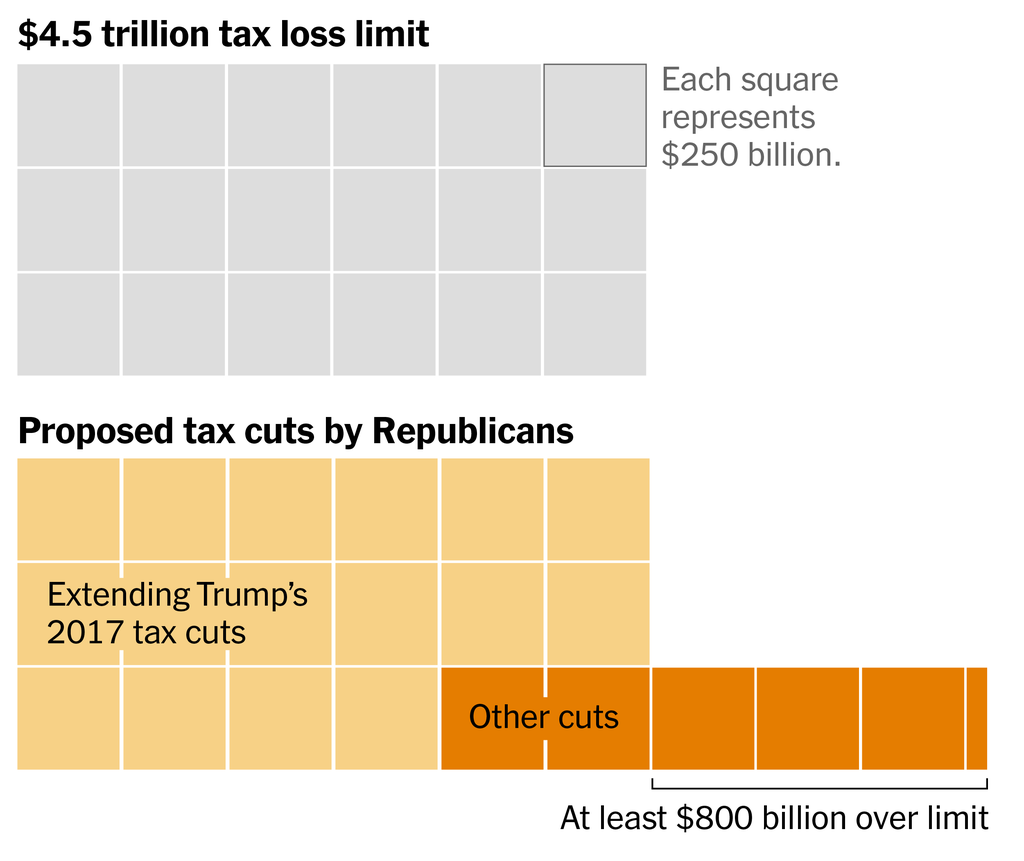
In the run-up to the election candidate Trump and Congressional Republicans made multiple promises to cut multiple taxes for multiple constituencies.  They cannot deliver on all of it as a consequence of a $4.5 trillion limit on the amount of money the federal budget can devote over the next decade to tax cuts. So, if you're looking forward to tax-free tips, tax-free Social Security, tax-free overtime pay and state and local tax (SALT) deductions something is gonna give.

First-off, if the GOP-controlled Congress wants to simply reauthorize the last round of tax cuts implemented during Trump 1.0 that will account for almost all of the $4.5 trillion cap leaving roughly $300 billion for everything else. 

Secondly, the GOP plan is contingent-upon an additional $2 trillion in spending cuts.  Anything less than that and the tax cuts are jeopardized.

A diagram compares the $4.5 trillion tax loss limit with the proposed tax cuts by Republicans, which would amount to at least $5.3 trillion — $800 billion over the limit.
Source: Committee for a Responsible Federal Budget | Not all proposed tax cuts are shown. | By The New York Times

 The non-partisan Committee for a Responsible Government has tallied these estimates for the next decade :

  • At least $100 billion not to tax tips 
  • At least $250 billion not to tax overtime
  • At least $550 billion to lower taxes on Social Security benefits
  • At least $200 billion to increase the deduction for state and local taxes

The challenge is that the sum total of these promises blows-up the budget.  Sure, Congress could end the subsidy for electric vehicles and scratch together something from that.  The trouble is that's all it is.  Scratch.  Chump change in a voluminous budget.  

Senate Republicans have floated the notion that if Congress simply reauthorize the Trump 1.0 tax cuts it doesn't cost anything. Since the old Trump tax cuts are currently in effect then maintaining the status quo costs nothing.  It is free.  Or at least that is the thinking.  If you consider that really thinking.  Just between you and me I know this brilliant thinking will blow-up the deficit and balloon the debt that any rational economist would tell you is already too large.  But I digress. 

Meanwhile, the debt ceiling looms large.  The tax cuts expire at the end of the year.  Hard deadlines make for hard work.  Time will tell.

Sunday, February 15, 2026

Crime Plunges

Marking the largest single-year drop on record and possibly the lowest murder rate since 1900, murders in major US urban centers  plummeted by over 20% last year.

Crimes in nearly all categories fell with 36% fewer robberies, 29% fewer carjackings and 25% fewer homicides compared to 2019.  

27 out of 35 cities surveyed saw declines in homicides chalking-up a year over year 20% decline nationwide compared to 2024.   At -60% Baltimore was witness to the largest drop while Los Angeles saw a 39% drop. 

According to the Council on Criminal Justice, burglaries fell by 45% and larceny by 20% compared to 2019. Despite remaining higher than 2019 levels, motor vehicle thefts fell by 27% last year compared to 2024.

The extent to which President Trump's policies are responsible is the subject of considerable debate between the administration and independent researchers.

The White House and Department of Justice (DOJ) cite several factors including the deployment of federal resources and army national guard personnel to major cities - specifically targeting Democrat-led Blue Cities characterized as war zones.  Surging ICE operations which targeted and removed thousands of criminal aliens from US streets.  And lastly encouraging stricter federal prosecutions and promoting a positive image of law enforcement to boost morale among rank and file police and recruitment.

In contrast, criminologists and organizations such as the Council on Criminal Justice and the Vera Institute argue that the 2025 drop is a continuation of a "virtuous cycle" that began in 2023.   Significant is as the social, economic, and psychological stressors of the COVID-19 pandemic receded, crime rates naturally began to revert to pre-2020 levels.  Experts credit the 2021 American Rescue Plan and the 2022 Bipartisan Safer Communities Act, which funded community violence intervention programs that reached peak effectiveness in 2024–2025.  Finally, policy changes typically take more than a few months to manifest in national statistics. Critics argue that Trump's 2025 cuts to DOJ grants for community safety may actually risk reversing these gains in 2026.  

On one hand factors contributing to this statistical avalanche include technology advances leading to precision policing and a reduction in court backlogs.  On the other hand, community-based programs implementing violence interrupters and even a generational shift in the data suggesting Gen Z committing fewer violent crimes are responsible.  

While the Trump administration's aggressive enforcement coincided with the record-breaking drop, the decline was already well underway by 2024. Most analysts believe the 2025 figures are too complex to parse and I'm disinterested in burning valuable bandwidth on someone's confirmation bias, selective cherry-picking or group-think.

Either way you slice it, crime in many cities has been falling since former President Biden's final two years in office.  The decline witnessed last year is a sharp reversal of the outlier pandemic-era surge that commenced during Trump's first term.   

For most of the last year I've been witness to more than enough reality television drama recently punctuated by the slaying of a couple of my countrymen; a singularly Trumpian Kent State moment. These deaths have had a profound impact upon my psyche; mostly a consequence of a small handful of acquaintances reveling and basking in the reflected glory of the slaying of Americans - for all the world to see on social media.  Absorb that readers; and allow it to register.  I don't care if it is Renee Good , Alex Pretti or Charlie Kirk; don't behave like a bloodthirsty damn ghoul.  Rejoicing in the gunning-down of other Americans reflects poorly.  

Drama-aside, there hasn't been much if any permanent progress on anything that will improve your and my prosperity and general lot in life. The budget and deficit have exploded to record levels and tariffs have increased the cost of living on all Americans. Nevertheless, this news from the crime blotter might just be evidence of our immediate world becoming a safer place.  Considering most everyone around here leave their keys in their vehicles I'm gonna embrace the drop.  Time will tell if it is lasting.  I'm a patient sort.....

Thursday, August 1, 2019

Red Ink

According to the nonpartisan public policy group Committee for a Responsible Federal Budget the budget deal that was passed by the House is expected to be approved by the Senate.  After which President Trump will sign into law an additional $4.1 trillion to the national debt.  Record-setting red ink.    

There is a low probability that enough GOP defections in the Senate may queer the deal.  If not - Republicans will own deficit-financed legislation. 

After railing against the debt and deficit for years it’s certainly not your daddy’s GOP any longer…..

Friday, May 2, 2025

Recession Watch

On Wednesday we learned that in the first quarter of 2025 the U.S. economy contracted by 0.3% on an annualized basis marking the first decline in nearly three years.
 
This downturn was primarily driven by a record trade deficit, as businesses front loaded imports ahead of new tariffs implemented by President Trump, which subtracted 4.8 percentage points from GDP. Consumer spending slowed to a 1.8% increase, influenced by factors such as harsh winter weather and post-holiday spending lulls.
 
While business investment remained strong due to pre-tariff stockpiling, government spending declined amid federal budget cuts and layoffs. Inflation rose to 3.6%, raising concerns about potential stagflation.
 
The Federal Reserve is expected to hold interest rates steady to balance inflation control with slowing growth. Analysts warn of a higher risk of recession if trade policies remain unchanged and domestic activity weakens.
 
A few thoughts:
  • There will be revisions to the GDP numbers.
  • The US economy is both dynamic and resilient.  Universally-accepted evidence of a recession is two consecutive quarters of negative growth.
  • We have yet to feel the full impact of the White House tax increases on trade.
This graph is a screenshot from a Wednesday morning podcast. The precipitous drop in container traffic implies we’ll feel supply chain disruptions beginning sometime in June.


Tuesday, November 5, 2024

Don't Forecast The Election

Last week, and before I left for South Dakota for a vacation and escape from the election nonsense, an email from a neighbor showed-up asking for me to make sense of an October Market Recap he had received from his financial guy.  This was a lay-up for me and I notified my pal that I would be happy to oblige - after I had returned from my ringneck-chasing getaway.  

I emailed him last evening as my last task before going to bed bone-tired.  What follows is a distillation of what I shared:

Neighbor...

What you received from Mr. So And So, CFP® is a rather detailed recap of the investment market's out-performance for YTD 2024.  It is nicely summarized and annotated with supporting details.

Contrary to some of the political rhetoric we've been subjected-to in the run-up to the election is the fact that the US economy is on a tear in most all of the sectors that matter.  Inflation has returned to normal and I paid $2.77 last week at the Brussels BP for a tank of unleaded regular.  You needn't look any further beyond the same observations and additional stats your guy provided.  None of that data is imaginary and the markets reflect it.  You, myself and others similarly situated in the 'ownership class' (retired owners of stocks, bonds and real estate with little if any debt) benefit greatly from an economic cycle such as this.  Emancipated from raising and educating our children our focus turns-back to children, grandchildren and great-grandchildren - but without the demands of a day job.

Getting back to the markets, and pointing out something your financial guy did not address, is an interesting implication for tomorrow's election.  When the S&P 500 Index rises in the final three months before the election the incumbent party typically remains in office.  Conversely, a drop in the index has historically indicated that the opposition will claim victory.

In 12 out of the 15 presidential elections since 1926 the ruling party has benefited from a strong stock market performance in the three months leading up to the election and went on to win.  That is an 83% streak.  

While a streak such as this would signal a Harris win; a streak is nothing more than a streak.  Streaks can be broken and I happen to believe that this election is too close to call.  Even the betting markets are evenly divided tonite.

If I was still in the day job, and was communicating with my clients, I would be telling them something on this order:  'It is important to be mindful that the outcome of the election (whether it suits your personal politics or not) is not a reason to react emotionally.  That invites investment mistakes.  If you don't like the outcome of this election, there is a high probability you will be pleased with the mid-term elections in 2026.  This is because the party that loses the race for the presidency this year will likely win the House in two years putting a halt to the new President's legislative agenda.  That's just the way things happen to play-out most of the time. '

I went on the explain that polling suggests that neither party will hold a super-majority.  In other words there will be divided government much as the Founders intended.  This will require compromise.

So, as we watch the returns tonite we should remain mindful that our Constitution has survived 235 years.  This will not be the last election and if the people dislike the policies they get; they'll get around to changing them eventually.   Blah, blah, blah.

I closed with an admonition on a subject (I have blogged about many times) - that being the federal debt and deficit.  The budgets under both Trump and Biden have manifested unprecedented deficits.  Given the reality of record high employment and our country not being at war this aberration absolutely requires attention in the years ahead.

What I did not share is my skepticism over either candidate rising to this task.  So time will tell.

All I gotta say is it has been a terrific game to watch for the last 16 weeks.  Sudden Death Overtime?  Who knows?

Sometimes elections, investment markets and football, are a roll of the dice.

See you all on the flip side....